Using Generative AI to Refactor Legacy COBOL Java Code
By Techserv International
The Automation Shift: Using Generative AI to Refactor Legacy COBOL and Java Code Safely
Are you quietly losing millions per annum running old inflexible software? CTOs, Enterprise Architects and Directors of Engineering within some of the largest financial networks, insurance groups and government systems in the USA are constantly challenged with ensuring stability within their systems. Billions of dollars are transacted daily on systems running on COBOL or older Java frameworks.
However, using such old languages can pose serious business risks. A lack of COBOL developers is getting worse globally. Additionally maintaining these huge monoliths is expensive, restricting integration with modern cloud platforms and posing serious security risks which can be difficult to resolve.
Modernizing the systems by manually rewriting millions of lines of code has become a well known nightmare! These manual projects typically span several years, run into huge budget overruns, and introduce massive risks of breaking core transactional workflows.
The definitive technical resolution in 2026 is using generative ai to refactor legacy cobol java code through automated pipelines. By combining trained Large Language Models (LLMs) with strict, isolated syntax checking tools, your company can safely convert messy legacy code into clean, scalable microservices. Let’s break down the technical framework required to accelerate your enterprise modernization safely with zero operational downtime.
The Modernization Bridge: Monolithic Mainframes to AI-Driven Microservices
To execute an automated code transformation safely, system architects must use a highly controlled, dual-verification translation pipeline:
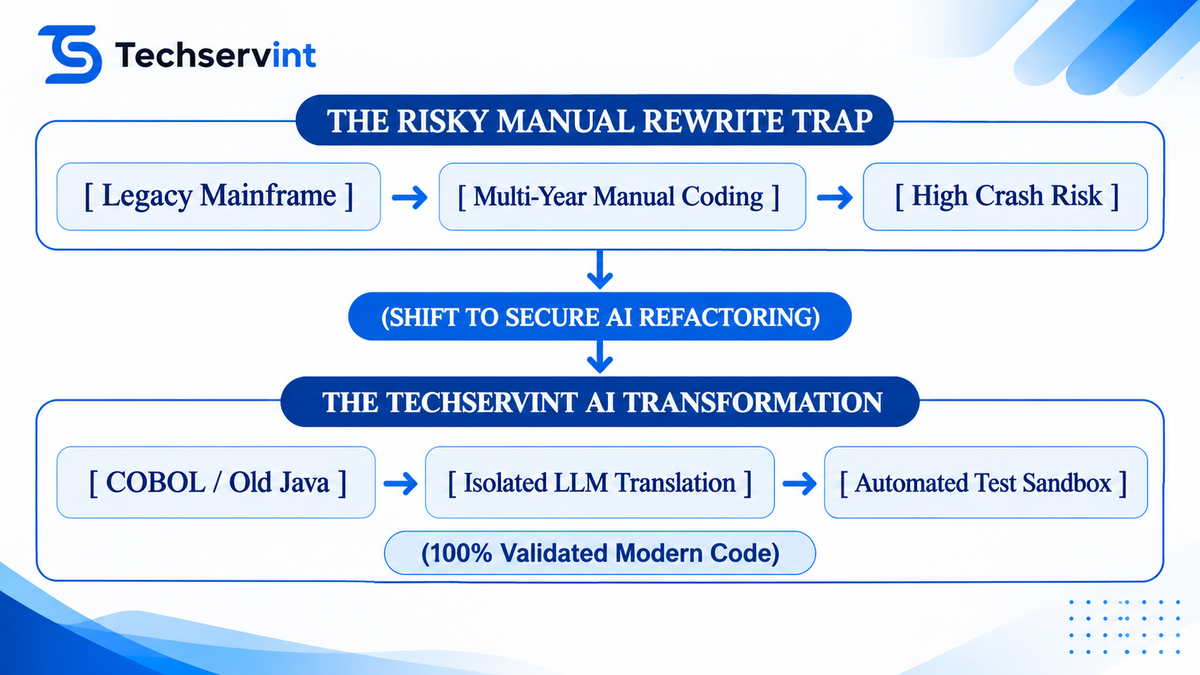
Legacy computing mainframes are incredibly reliable at handling basic, heavy transactional operations. However, because they lack modular structures, a simple database modification requires rewriting deep system rules.
This is completely transformed by Generative AI. You no longer have to get your human developers to manually parse and translate millions of lines of unstructured COBOL files into something they can work with. Instead, the AI will do this automatically. It will parse, document and understand the COBOL code logic. It will then convert the legacy code blocks into clean, modular object classes using modern languages such as Java 21, TypeScript, or Go.
Crucial Strategic Benefits of AI-Driven Code Refactoring
Automate the upgrade of your Enterprise Code Infrastructure with Generative Pipelines to gain fast competitive and financial benefits:
- 70% Reduction in Time to Production: Convert years of Mainframe development using automated translation scripts to complete in months.
- Instant Optimization of Developer Resources: Free up your top engineering teams from tedious translation work, allowing them to focus entirely on building modern business features.
- Elimination of the Legacy Talent Crisis: Safely transition your core transactional data flows into modern languages that are easy for today’s developer talent to maintain and expand.
- Seamless Cloud and API Integrations: Breaking down legacy monoliths allows you to instantly connect your core data to public cloud resources and automated API gateways.
Technical Framework: Our 5-Step Safe AI Refactoring Process
We have a 5-step process that ensures your core code can be translated between entirely different languages safely. At Techservint, we secure your technical assets using this proven five-step development roadmap:
Step 1: Abstract Syntax Tree Mapping
We never feed raw code blindly into a public language model. Our engineers extract your legacy files and pass them through local parsing tools to construct a comprehensive Abstract Syntax Tree (AST). This creates an exact logical map of your application dependencies and hidden rules before any code translation begins.
Step 2: Contextual Window Ingestion
In order to translate the code accurately we use our bespoke code generation models that are trained on your legacy systems. This gives the AI the ability to ingest your code along with its historical documentation. This ensures we don’t lose any of the complex calculations within the core of your systems.
Step 3: Architecture Decomposition
As the AI ingests your legacy system it will use our bespoke system frameworks to decompose the code. The AI will automatically detect each separate capability within your system and convert it into a microservice. This could be user billing or compliance logging.
Step 4: Quality Assurance & Differential Testing
We ensure that the generated code is 100% accurate by placing the new code into a sandboxed environment. An automated script will run differential testing. The historical data is passed through your legacy system and the new AI generated systems. This will ensure that the data output matches.
Step 5: CI/CD Implementation & Monitoring
Once the new application has passed all of our safety tests we will implement the microservices into a modern cloud service (AWS/Azure). We will also implement centralized monitoring so that you can monitor your system performance, security access and network health live.
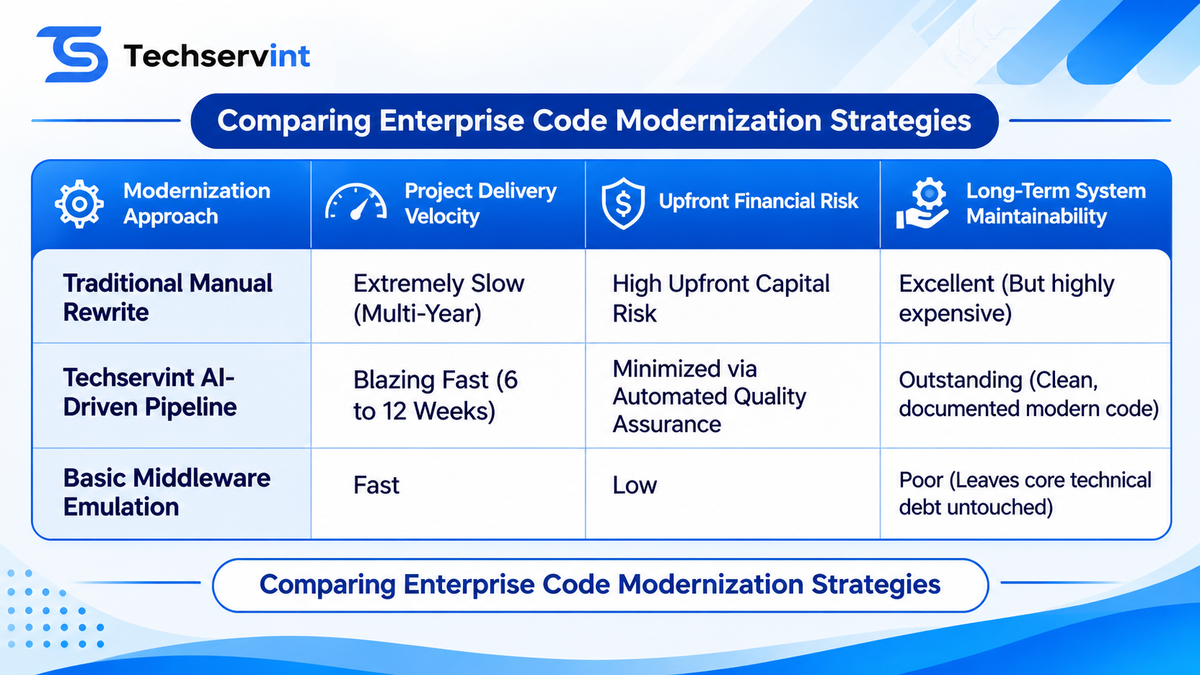
Comparing Enterprise Code Modernization Strategies
Every scaling corporation manages its technological transformation based on distinct cash constraints, time-to-market boundaries, and risk tolerances. The comparison matrix below details the three primary methods:
Overcoming Key Technical Challenges in AI Refactoring
Using artificial intelligence to modify large-scale enterprise source code introduces unique structural and security hurdles. Here is exactly how our specialized development teams solve them for your business:
Challenge 1: Eliminating Hallucinations
- The Problem: The issue is that the standard language generation models will occasionally produce incorrectly logical code or fake functions, also known as hallucinations.
- The Techservint Solution: We completely eliminate code hallucinations by bounding the AI tool within strict, automated compilers and syntax-checking scripts. If an AI produces any lines of code that don’t pass the static analysis, or has even a decimal difference in its unit testing, we will automatically reject it and re-prompt.
Challenge 2: Ensuring Data Security During Ingestion
- The Problem: Passing proprietary corporate code blocks through public cloud AI engines leaks your private intellectual property and violates strict USA security standards.
- The Techservint Solution: We create zero-trust development environments using our 100% private open source code models that reside within your secure cloud environment meaning your source code will never leave your environment.
Challenge 3: Lack of Legacy Documentation
- The Problem: Most mainframes have been updated by dozens of developers over 30 years meaning there is very messy code without any source documentation or comments.
- The Techservint Solution: We deploy specific AI parsing agents designed to analyze raw code paths and automatically write comprehensive, clear system documentation and unit tests for every newly generated microservice module.
Why Choose Techservint as Your Enterprise Transformation Partner?
Techservint is a leading custom software development and enterprise digital transformation agency. We specialize in helping modern organizations maximize their computing assets through intelligent business automation components and highly secure, scalable software architectures.
We refuse to provide superficial solutions or trial-and-error software configurations. Our software engineers create robust, scalable database components which are dedicated to ensuring there is no risk to your data integrity, downtime or unclear financial returns. We combine our vast experience of migrating legacy code with state-of-the-art artificial intelligence design to ensure you have the ultimate technical solution to confidently lead your market.
Frequently Asked Questions (FAQs)
Can generative AI deal with very complicated / un-documented COBOL scripts?
Absolutely. It works extremely well when using rigid AST parse wrappers and well tuned validation models to extract the logic and intent behind the legacy code and produce clean, modern software, much quicker than a human team could.
Will there be any downtime during our mainframe migration?
No. Your legacy system will continue running as normal handling your daily transactions. The new microservices will be developed and fully validated within sandboxes and everything will be switched over during the weekend.
What languages should we target during the refactor?
Whilst we will tailor your target framework to work with your infrastructure we usually convert mainframe code into Java, Go or Python microservices to help provide the fastest application performance and scalability within the cloud.
Ready to Streamline Your Legacy Systems and Save on Maintenance Costs?
If you have inflexible legacy mainframes that are eating into your annual tech expenditure it is time to do something about it! Partner with Techservint to safely extract your core business logic using advanced, high-performance generative AI refactoring pipelines designed to protect your data assets.
Our elite team of enterprise software developers is standing by to structure a low-risk, high-impact digital strategy aligned perfectly with your long-term expansion milestones.