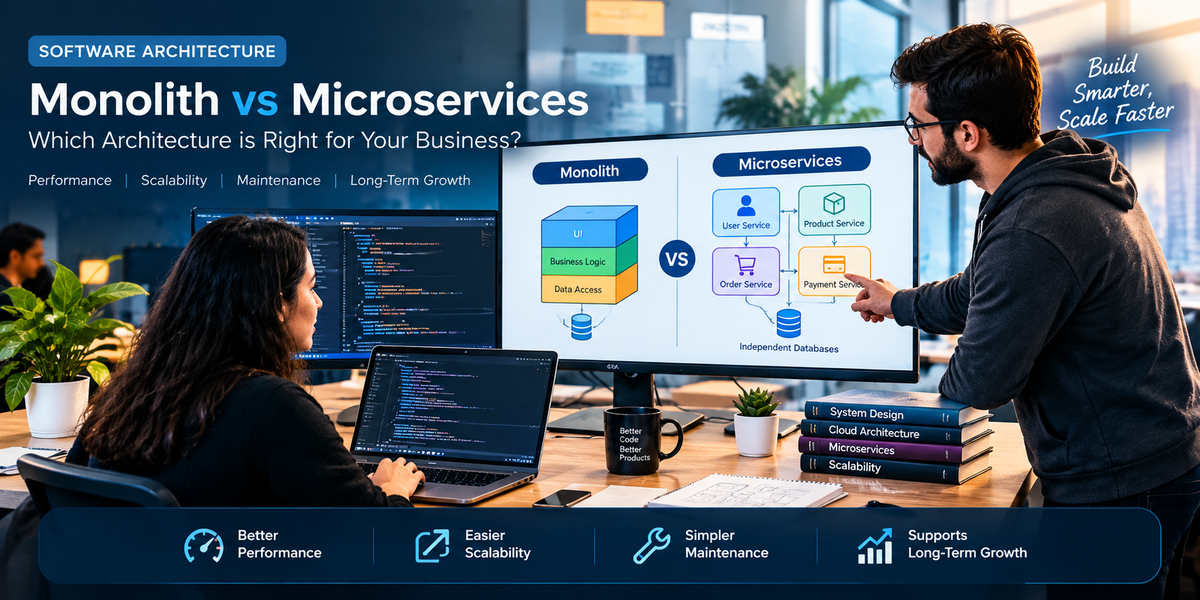
Replacing Monolithic Architecture with API First Architecture
By Techserv International
Beyond the Monolith: Replacing Legacy Architecture with API-First System Design
Is your company's growth being throttled by a rigid, slow-moving software codebase? For established enterprises across the USA, scaling operations on an aging technical framework presents a massive business hurdle. Features that should take days to launch end up taking months, simple deployments risk breaking core systems, and data remains trapped inside frustrating operational silos.
The primary cause behind these bottlenecks is an outdated, monolithic codebase where the user interface, backend server logic, and database layer are tightly fused together. Making even a tiny patch to one element requires rebuilding and deploying the entire system. To survive and thrive in today's digital market, engineering teams must transition toward modern software development frameworks.
Replacing monolithic architecture with API first system architecture offers the ultimate path to complete digital transformation. This modular system design decouples your data layer from individual front-end channels, allowing your business to scale individual components independently, innovate faster, and dramatically cut long-term infrastructure costs. Let’s break down exactly how you can execute this migration safely without disrupting your active daily production environment.
What is Monolithic vs. API-First Architecture?
To understand how to safely decouple your platform, you must contrast these two fundamentally opposite engineering methods:
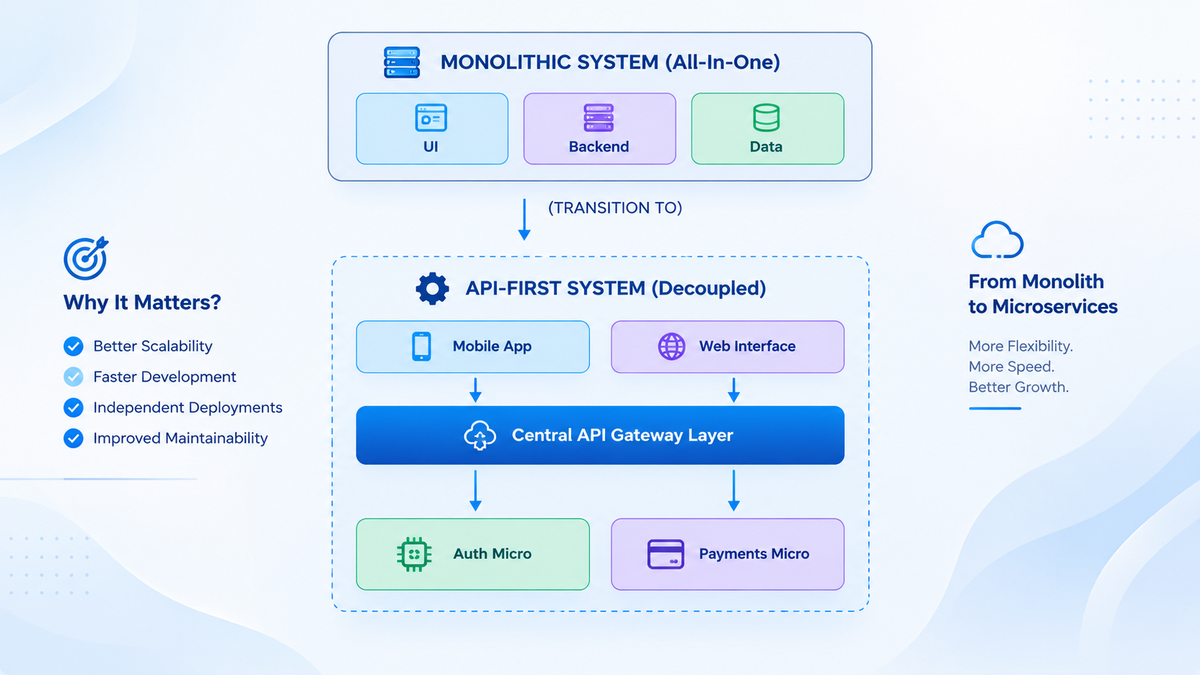
A monolithic architecture treats the entire software program as a single, indivisible unit. The code shares resources, data models, and memory spaces. If your user traffic suddenly spikes on a specific feature, you are forced to clone and upscale the entire monolith codebase across multiple servers, running up massive computing bills.
Conversely, an API first system architecture shifts the entire approach. Before any frontend user interface is designed, developers construct independent, highly modular microservices. These modules communicate seamlessly with each other through structured API endpoints. This approach treats data access as a universal service, allowing any authorized application, mobile interface, or external partner tool to tap into your core system logic instantly.
Key Business Advantages of API-First Systems
- True Tech Stack Freedom: Your frontend engineers can build beautiful interfaces using modern tools like React or Next.js, while your backend engineers safely optimize core logic in Python, Go, or Node.js.
- Flawless Multi-Platform Delivery: Build your backend engines once, then easily distribute that data across web dashboards, native mobile apps, and IoT devices simultaneously without duplicating code.
- Rapid Deployment Lifecycles: Instead of risking a complete system crash during massive code deployments, independent engineering teams can continuously push updates to isolated microservices.
- Elimination of Vendor Lock-In: Modular frameworks let you easily swap out internal components or integrate with third-party SaaS services without altering your core database structure.
Technical Roadmap: The 5-Step Migration Process
Step 1: Mapping Boundaries and Domain Auditing
We begin by thoroughly reviewing your monolithic codebase to identify explicit domain boundaries. Using industry-proven Domain-Driven Design (DDD) principles, we isolate distinct operational domains (e.g., identity verification, transaction invoicing, inventory tracking) to figure out exactly how to break the monolith apart.
Step 2: Implementing the Central API Gateway
Before touching or extracting any core database tables, we introduce a robust API Gateway layer (such as AWS API Gateway, Kong, or Apigee) directly in front of the monolith. This gateway acts as a smart traffic cop, safely routing client data requests to the legacy monolith while providing a clean interface for new apps to connect to.
Step 4: Decentralizing and Migrating Databases
A true API-first migration requires breaking down monolithic databases. We carefully decouple shared data tables, giving each newly created microservice its own dedicated, isolated database layer to completely eliminate cross-system data dependencies.
Step 5: Automating with CI/CD Pipelines
To close out the migration, we implement advanced Continuous Integration and Continuous Deployment (CI/CD) pipelines. This ensures that every individual microservice undergoes automated testing, container tracking, and rapid cloud deployment without requiring manual maintenance overhead.
Selecting Your Core System Transition Path
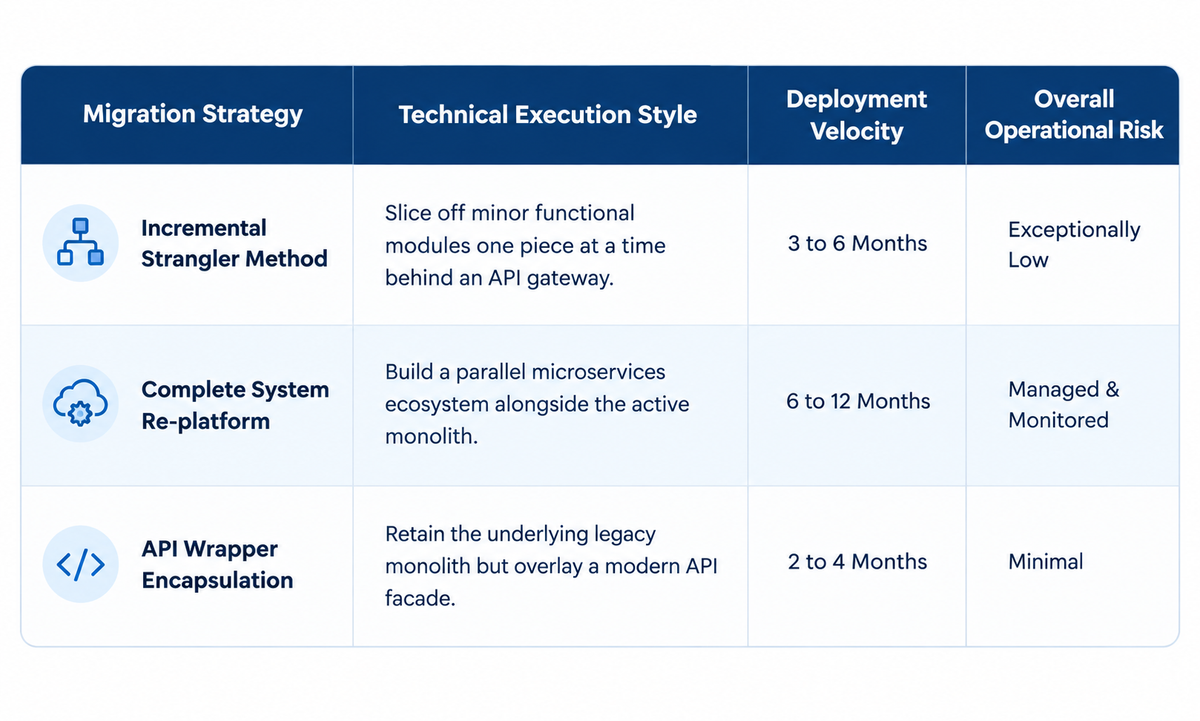
Every organization handles migration based on different business goals, budget sizes, and operational risks. The comparative matrix below details the three primary architectural paths for modern software modernization:
Overcoming Critical Architectural Transition Challenges
Moving away from a legacy monolith introduces distinct structural challenges. Here is exactly how our engineering teams handle and resolve those hurdles for your business:
Challenge 1: Managing System Distributed Data Consistency
- The Problem: When separate microservices hold independent databases, maintaining transactional data consistency across different applications becomes highly complex.
- The Techservint Solution: We implement the advanced Saga architecture pattern. This framework manages distributed transactions using asynchronous event-driven messaging, ensuring that if one step fails, compensating rollbacks automatically trigger across all data stores.
Challenge 2: Network Latency and API Overhead
- The Problem: Breaking a local monolithic app into dozens of separate distributed cloud services can introduce network latency due to continuous API calls.
- The Techservint Solution: We optimize system speeds by deploying ultra-fast gRPC protocols for internal backend communication, utilizing Redis memory caching layers, and bundling complex client data queries through GraphQL gateways.
Challenge 3: Complex Security Perimeter Management
- The Problem: Monoliths are secured behind a single system firewall. In contrast, an API-driven microservices setup expands your digital surface area, introducing new potential security vulnerabilities.
- The Techservint Solution: We establish zero-trust infrastructure environments using centralized OAuth2 and OpenID Connect identity protocols, combined with mutual TLS (mTLS) encryption, ensuring every single API call is fully authenticated and protected.
Why Partner with Techservint for Your Digital Transformation?
Techservint stands out as a premier custom software engineering and enterprise cloud consulting agency. We help modern organizations break free from technological stagnation by architecting robust, highly scalable API-first platforms.
We do not believe in offering superficial patches or pushing clients into high-risk, unvetted software overhauls. Our engineering teams prioritize rock-solid cybersecurity, continuous system uptime, and measurable business ROI above all else. By blending extensive legacy code modernization experience with cutting-edge microservices engineering, we provide your business with the ultimate infrastructure to scale infinitely.
Frequently Asked Questions (FAQs)
How long does it take to completely replace a monolithic architecture?
Depending on the size and complexity of your enterprise codebase, an incremental migration following the Strangler Fig pattern typically spans anywhere from 3 to 9 months. However, your business will begin seeing measurable performance improvements within the first 60 days as the initial microservices go live.
Will migrating to an API-first design disrupt our live user operations?
No. By prioritizing an incremental migration style and routing all system traffic through a smart API gateway, your production environment remains completely online, secure, and fully operational for your customers throughout the entire process.
Is an API-first system layout more expensive to maintain than a monolith?
While the initial development setup requires an upfront investment, long-term operational costs are significantly lower. You save money by scaling only the specific cloud resources your features actually consume, minimizing server waste and dramatically reducing debugging and development hours.
Ready to Scale Your Enterprise Infrastructure?
Stop letting rigid, outdated IT frameworks slow down your market expansion. Partner with Techservint to safely transition from an unmanageable monolithic system to a highly scalable, agile, and secure API-first architecture.
Our elite team of software development experts is standing by to map out a low-risk, high-impact technical path aligned with your long-term growth goals.
Schedule Your Free Enterprise Discovery Strategy Session Today