Reducing Data Latency in Cloud Applications Edge Computing
By Techserv International
Speed Optimization: Reducing Data Latency in Cloud Applications Using Edge Computing Architectures
Is an agonizing millisecond delay in your application processing time quietly driving away your digital users? For CTOs, systems architects & engineers in the USA platform speed is a key metric. Whether your system is used for live financial trading, global e-commerce or IoT asset tracking, users expect instant performance.
The main issue with achieving fast digital performance, is traditional centralized cloud architectures. If your application and database are hosted in one place like AWS us-east-1 Virginia then when a user makes a request it has to travel thousands of miles. This can cause serious issues with bottlenecks, high network costs and latency issues.
The best way to optimize performance is reduce latency in your cloud applications by using an edge architecture. Moving your critical processes, memory and APIs from your central servers into a distributed network will remove all lag from your network, reduce your bandwidth usage and give your users a smooth experience. Let’s look at how you can design a secure low latency edge architecture for your platforms.
The Latency Paradox: Centralized Cloud vs. Edge Computing
To build a high-performance network ecosystem, systems architects must move away from rigid, single-origin data hubs toward a decentralized, distributed network structure:
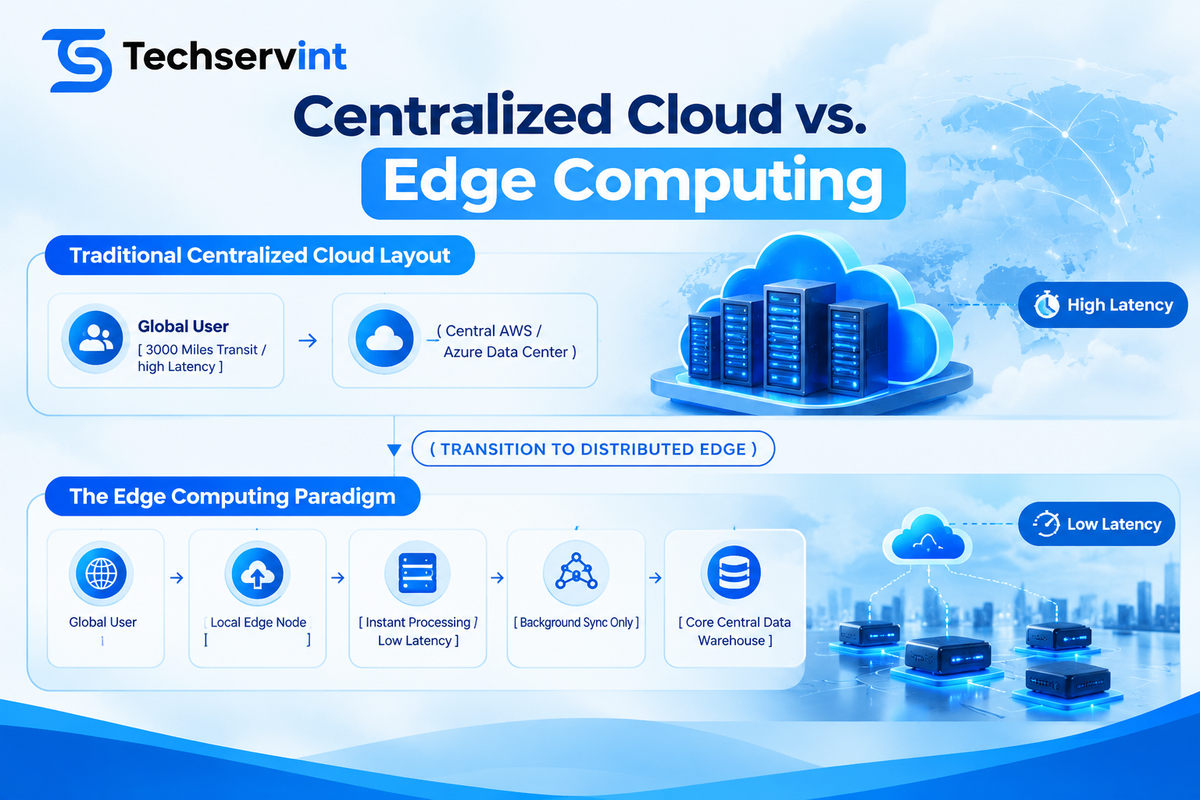
Traditional application development models treat the cloud as a singular, far-away destination. Your servers process every minor background script, user permission check, and simple text modification inside that central mainframe. When millions of global users hit your public web addresses simultaneously, this design creates severe processing queues and stretches round-trip times (RTT) to painful lengths.
An edge computing architecture resolves this data transit issue by deploying a distributed layer of smart, localized micro-servers directly at the network's perimeter. Instead of forcing a user's phone to connect back to a central server room across the country, requests are instantly caught and processed by an edge node located in their local city. The edge layer handles lightweight calculations locally, routing only essential data updates back to your core database warehouse in the background.
Key Strategic Advantages of Edge Architectures
By moving to a local edge model you gain some very real competitive advantages:
- Improved System Response Times: Reduce your system response times from hundreds of milliseconds to sub-milliseconds.
- Lower Data Bandwidth Costs: Reduce the data being sent to your cloud servers by reducing, filtering and processing user data at the edge.
- Improved System Availability: Being able to run your systems locally means you can still perform basic actions within your applications even if there is a temporary network failure at your central datacentre.
- Improved Protection Against DDoS attacks: Catch high volumes of malicious bot traffic instantly at the edge to protect your central server.
Technical Process: 5 Steps to Create Low-Latency Architectures
In order to turn any traditional cloud environment into a high distributed architecture, we follow a strict process to mitigate risks. At Techservint, we accelerate system speeds using this field-tested engineering framework:
Step 1: Conducting a workload Audit
We will carry out an audit of your current application components by our senior Infrastructure Architects. This will include identifying dependencies, calculating bandwidth requirements, identifying latency tolerance and determining what functions to move to the edge (authentication checks or image resizing), and what to leave in the main directory.
Step 2: Implementing edge serverless functions
Key parts of your application will be rewritten using a lightweight serverless solution (Cloudflare Workers, AWS Lambda@Edge, Vercel Edge Functions). This means that your scripts will run on the local edge runtime.
Step 3: Cache data on the edge
We implement intelligent caching so that data can be retrieved as quickly as possible. This is done using popular caching databases such as Redis or Memcached. Frequently accessed non-private data will be stored within your edge network so any static data can be retrieved instantly.
Step 4: Synchronise data using edge databases
Keeping data consistent across a distributed architecture can be very complex. We deploy modern edge databases (DynamoDB Global Tables, Turso, Macrometa) to automatically sync and mirror your active data tables across all of your global servers.
Step 5: Monitor everything
Once deployed we implement monitoring tools (OpenTelemetry, Datadog, New Relic) to monitor your edge network in real-time. This will give your developers full insight into how long everything is taking to process across all platforms, what errors are appearing locally and how the serverless functions are performing.
Choosing Your Cloud Optimization Infrastructure Path
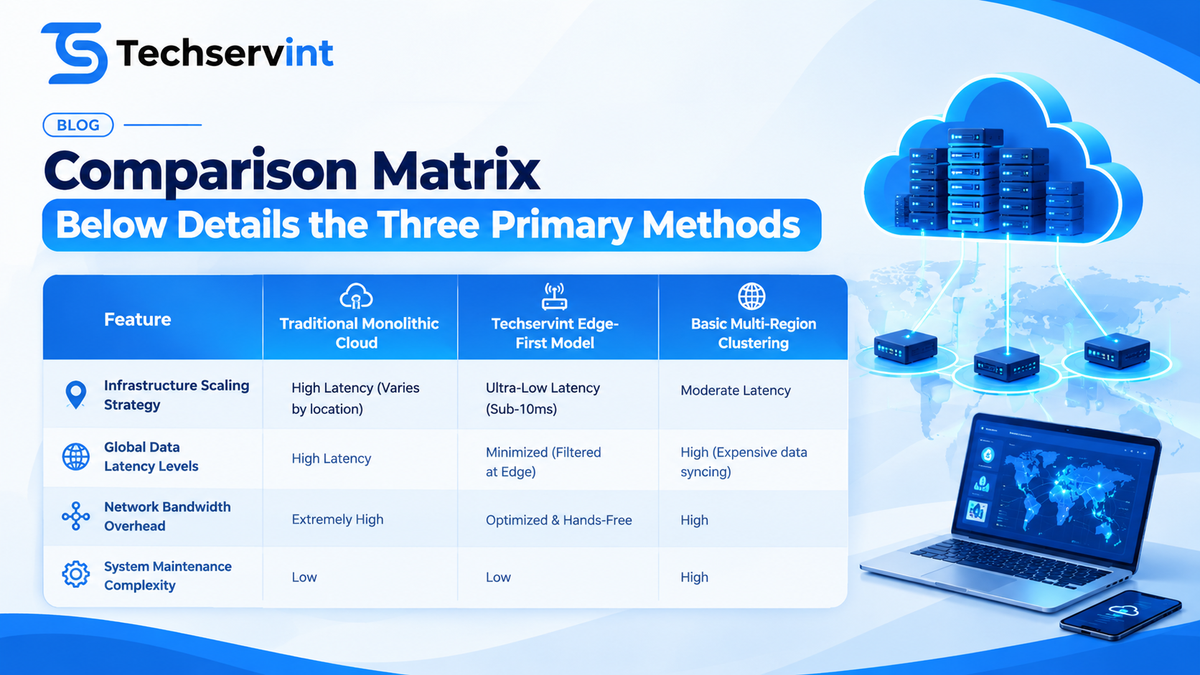
Every scaling technology venture manages system architecture based on distinct global traffic patterns, development budgets, and application performance targets. The comparison matrix below details the three primary methods:
Overcoming Critical Technical Challenges in Edge Engineering
Building a globally distributed computing layer introduces complex database and data consistency challenges. Here is exactly how our specialized development teams solve them for your business:
Challenge 1: Resolve conflicts when updating data across a distributed database
- Problem: If two users update the same database entry at the same time from different edge nodes in different regions of the world it can cause serious issues with the data becoming corrupt due to race conditions.
- Solution: We resolve conflicts between duplicated data by using Conflict-Free Replicated Data Types (CRDTs). This guarantees that there are no issues with data synchronization as we use specific consensus algorithms to guarantee that all updates to the distributed database happen in sequential order.
Challenge 2: Secure your distributed perimeter
- Problem: As you are constantly moving code between many edge nodes across the globe it can increase your attack surface.
- Solution: We set up strict zero trust infrastructures using WebAssembly (Wasm) isolation, end to end mTLS data encryption and local token validation to guarantee complete security.
Challenge 3: Cache invalidation delays
- Problem: If cached product data isn’t invalidated quickly enough on an edge node after an update to the central database then application users will see incorrect information.
- Solution: We utilize advanced cache invalidation webhooks. The moment your core database updates, the system instantly broadcasts purge commands across all global edge nodes within milliseconds.
Why Partner with Techservint for Your Infrastructure Optimization?
Techservint is a leading custom software development and enterprise cloud optimization agency. We specialize in helping modern organizations maximize their computing assets through intelligent business automation components and highly secure, low-latency system design patterns.
We don’t believe in quick fixes or forcing clients into a strict server framework; our software engineers have developed robust scalable database components to ensure your data remains secure, up and running at all times and provides clear financial ROI. We combine our in-depth knowledge of network infrastructures with innovative edge computing architecture to provide you with the ultimate technical solution to ensure your business can stay ahead in their market.
Frequently Asked Questions (FAQs)
Do I need to move to a different cloud provider?
No. Edge computing solutions are designed to be a fast optimization layer on top of your existing cloud infrastructure. Simply connect your edge script workers to your main databases which will be on AWS, Google Cloud, Azure or on-premise.
Are edge computing solutions secure enough for financial/medical data applications?
Yes. Modern Edge Computing provides secure sandboxed WebAssembly containers for running code. All tokens are encrypted throughout their journey..
How long until my application is deployed?
Depending on the complexity of your current backend application you should expect between 6-10 weeks planning your domain boundaries, adding your serverless Edge workers and deploying your secure intelligent caching layer.
Ready to Obliterate App Lag and Scale Your Platform Globally?
Stop letting rigid, slow network setups throttle your company's digital expansion. Partner with Techservint to securely deploy high-performance edge computing tools and robust system guardrails designed to completely eliminate data latency.
Our elite group of enterprise-level software developers will help you create a low risk digital strategy with huge impact.