Odoo Customization Hidden Costs vs Custom Software
By Techserv International
The Real Math: Odoo Customization Hidden Costs vs. Building Custom Software from Scratch
Are your enterprise software integration bills quietly spiraling out of control?For scaling businesses across the USA, selecting the foundational infrastructure to run core operations is one of the most critical financial decisions a leadership team will ever make. When legacy systems begin to buckle under new operational volumes, executives generally find themselves at a major technological crossroads: do they adopt an established open-source ERP system like Odoo and modify it, or do they build a proprietary application tailored entirely to their processes?
At first glance, opting for a pre-built platform seems like a financial no-brainer. The upfront license fees are low, the basic features are ready out of the box, and the initial deployment timelines look incredibly fast. However, many organizations fall into a costly trap, realizing too late that heavily warping a rigid ERP framework to match unique corporate workflows triggers a cascade of compounding technical debt.
Making the right choice demands an honest look at odoo customization hidden costs vs custom software scratch build frameworks. By breaking down long-term developer fees, system upgrade vulnerabilities, and resource consumption metrics, your team can avoid expensive software mistakes and protect your long-term return on investment (ROI). Let’s look at the real financial math behind both strategies to determine the most profitable path for your infrastructure scaling.
Deconstructing the ERP Illusion: The True Cost Matrix
To understand how software expenses shift over a typical five-year corporate lifecycle, look at how development hours are distributed across both models:
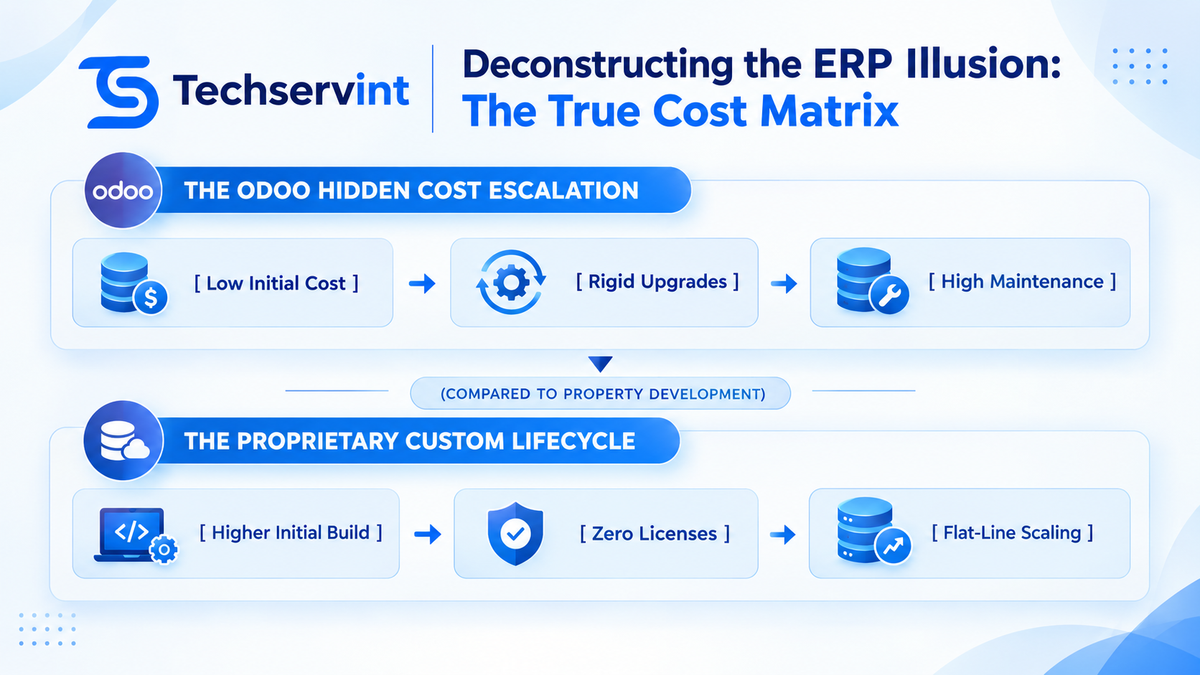
When an enterprise chooses Odoo, they are buying a highly structured boilerplate database template. If your operational workflows match Odoo's default modules (like standard retail invoicing or basic CRM tracking), the implementation remains highly affordable.
The financial friction begins when your business model demands specific deviations. Because Odoo's inner code framework is highly interconnected, overriding a default workflow to handle complex logistical routing or specialized multi-tiered pricing matrices requires extensive development work. Instead of writing clean business features, your developers spend valuable hours fighting Odoo’s native source constraints, writing complex inheritance layers, and building custom workarounds that can easily break during the next official system upgrade cycle.
The Hidden Financial Leaks in Heavy Odoo Deployments
Modifying an out-of-the-box system past a specific boundary introduces several unseen operational expenses:
- The Version Migration Tax: Every time Odoo releases a major version update, your custom extensions must be manually audited, debugged, and rewritten by specialized engineers to prevent system crashes.
- Compounding App Marketplace Subscriptions: Relying on third-party marketplace plugins to patch functional gaps creates software bloat, security liabilities, and unpredictable monthly licensing overhead.
- Database Performance Tuning Drag: Forcing heavy, non-standard enterprise calculation logic into a rigid PostgreSQL database structure can slow down system speeds and require expensive cloud server upgrades.
- User-License Financial Scaling Scaling: As your corporate workforce expands, seat-based user pricing structures quietly inflate your annual software baseline costs, draining money that could fund core product development.
Technical Framework: When to Customize vs. When to Build
Making an objective engineering decision requires analyzing your business's core operational needs against specific software application development models. At Techservint, we guide clients through this decision using a highly analytical framework:
Rule 1: Evaluate the Uniqueness of Your Core Value Proposition
If your primary operational workflows are standard (e.g., general bookkeeping, standard inventory counting, basic HR tracking), Odoo Customization is highly efficient. However, if your business relies on a proprietary algorithm, unique logistics pipelines, or specialized consumer experiences that set you apart from competitors, building a Custom Software Scratch Build ensures your code remains an uncompromised corporate asset.
Rule 2: Calculate the Long-Term Integration Overhead
Odoo communicates beautifully within its own sandbox. But if your tech stack demands continuous real-time data syncs with dozens of external third-party software applications, custom webhooks, or legacy industrial hardware IoT systems, building a decoupled API-first custom backend from scratch eliminates the need for expensive middleware translation layers.
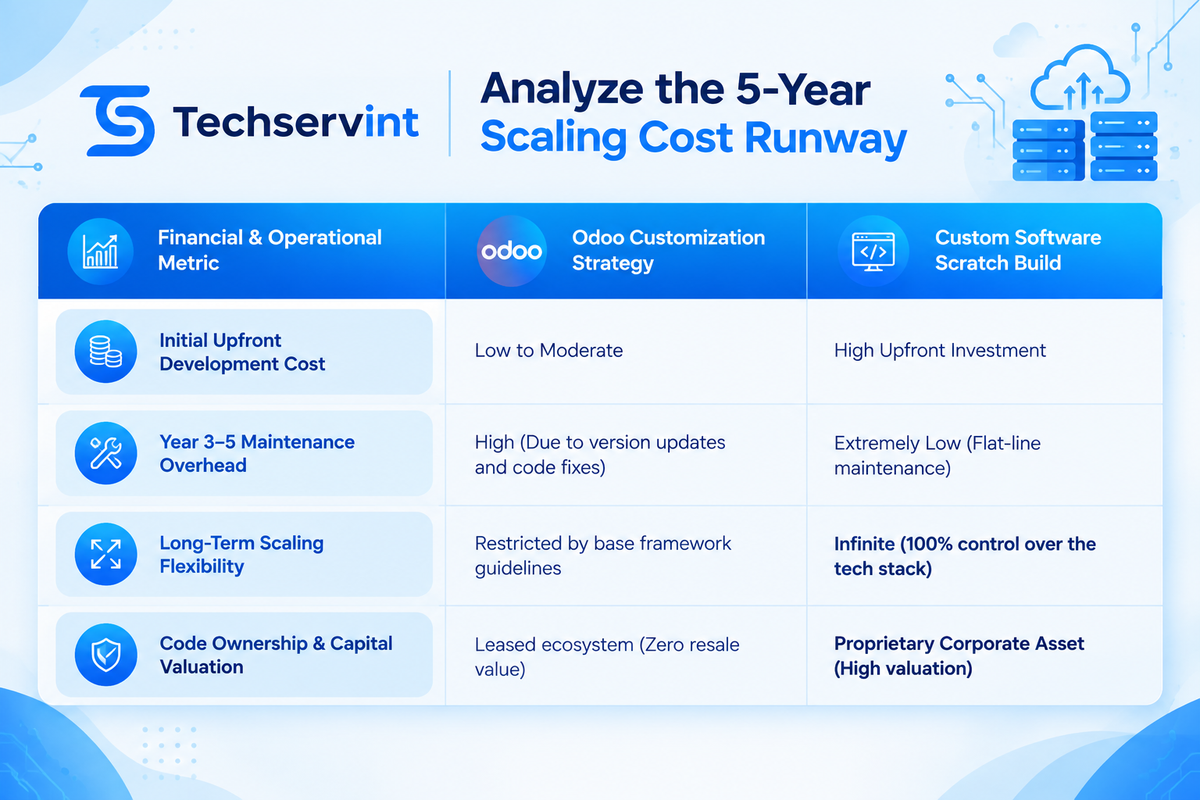
Rule 3: Analyze the 5-Year Scaling Cost Runway
The chart below shows how the total cost of ownership shifts over time between both development strategies:
Executing a Risk-Mitigated Custom Software Build
If the math points toward a custom build from scratch, non-technical founders often worry about initial development delays. At Techservint, we eliminate software risks by executing a lean, modern engineering roadmap:
1. Building on Modular API-First Microservices
We never design monolithic custom software that becomes difficult to manage over time. We engineer your proprietary system using decoupled microservices, ensuring separate modules (like payment gateways or warehouse logs) scale independently without affecting the rest of the application.
2. Leveraging Production-Ready Code Boilerplates
Building from scratch does not mean writing every line of login or database connection code by hand. We use heavily vetted, open-source engineering templates and serverless frameworks to fast-track foundational coding, cutting production times down significantly.
3. Implementing Continuous Automated Testing Pipelines
To guarantee complete application stability, your custom platform is plugged into advanced CI/CD pipelines. Every code adjustment triggers automated quality assurance checks, stress-testing your systems to ensure smooth performance under heavy corporate workloads.
Why Partner with Techservint for Your Next Software Move?
Techservint is a leading custom software development and enterprise cloud optimization agency. We specialize in helping modern organizations maximize their computing assets through intelligent business automation components and scalable database architectures.
We do not push generic software templates or advocate for unnecessary, high-risk system replacements. Our engineering teams prioritize rock-solid cybersecurity, continuous system uptime, and transparent financial ROI above all else. Whether you need a highly optimized, upgrade-safe Odoo implementation or a blazing-fast proprietary enterprise platform built from the ground up, we deliver the exact technical architecture your business needs to dominate its market.
Frequently Asked Questions (FAQs)
At what point do Odoo customization costs overtake a custom software build?
As an engineering rule of thumb, if your operational requirements force you to modify more than 30% of Odoo's native module logic, the long-term costs of maintenance, debugging, and broken upgrades will quickly overtake the upfront investment of a custom build from scratch.
Is proprietary custom software harder to secure than an established ERP like Odoo?
No. While Odoo benefits from a large community patching public vulnerabilities, custom software built from scratch has a smaller digital footprint, making it less attractive to automated hacking bots. By following top-tier security standards like OAuth2 and data encryption, custom software can easily exceed standard ERP security layers.
Can we migrate our data out of Odoo if we decide to build custom software later?
Yes. Odoo runs on an open PostgreSQL database model, allowing you to cleanly export your historical data tables into standardized formats (like JSON or CSV) whenever you are ready to transition to a proprietary system.
Ready to Make the Smartest Technology Investment for Your Business?
Stop draining your annual IT budget on unpredictable software modifications and fragile system patches. Partner with Techservint to analyze your business workflows and safely deploy a high-performance software setup engineered specifically around your long-term scaling milestones.
Our elite team of software development architects is standing by to map out a low-risk, high-impact digital plan aligned perfectly with your long-term growth targets.