Integrating AI Workflows into Legacy Enterprise Software
By Techserv International
Integrating AI Workflows into Legacy Enterprise Software: The Ultimate Engineering Guide
Is your legacy enterprise software quietly draining your operational budget? In the fast-moving USA enterprise sector, relying on decades-old, rigid systems creates massive data silos, slows down execution speeds, and requires millions of dollars in maintenance. Yet, completely replacing these core applications introduces massive operational risks, multi-year delays, and potential business disruptions.
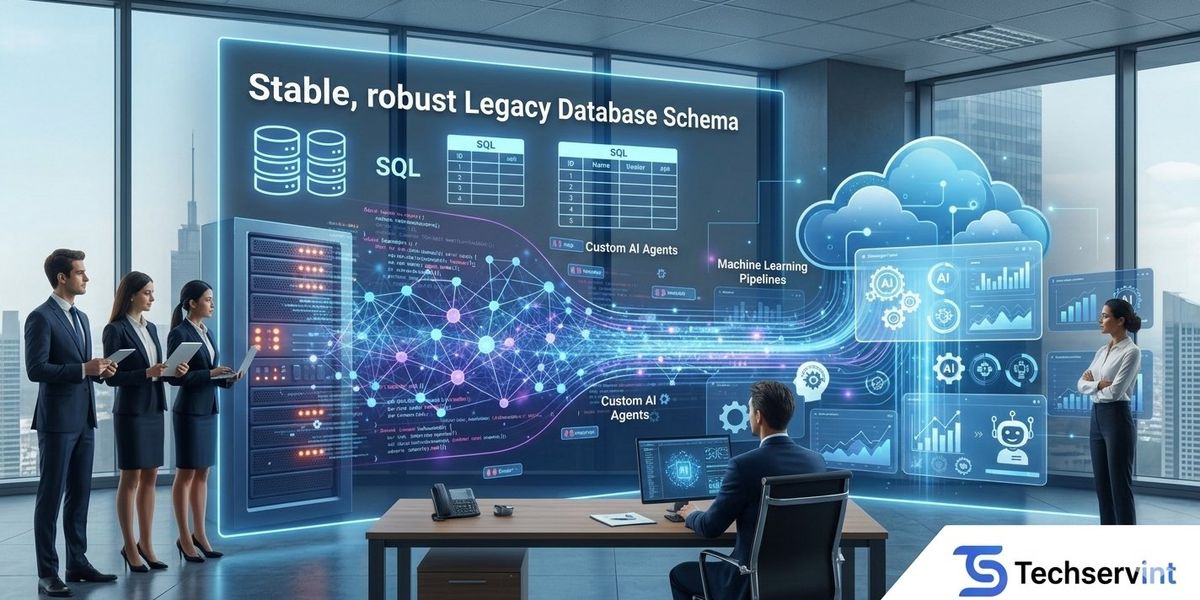
The smartest technical resolution is non-invasive software modernization. By integrating AI workflows into legacy enterprise software, US enterprises can seamlessly inject intelligent automation, predictive data analysis, and advanced natural language models directly into their existing, stable codebases.
Instead of undertaking an incredibly expensive system overhaul, you can use specialized middleware layers to connect machine learning models and automated AI agents directly to your foundational mainframes. This balanced methodology allows your business to innovate rapidly while preserving structural integrity. Let’s look at a practical, step-by-step roadmap to modernizing your data pipelines, eliminating operational inefficiencies, and driving measurable technical ROI.
What is Legacy Software AI Integration?
Legacy software AI integration is the tactical process of embedding modern cognitive capabilities—like machine learning, large language models (LLMs), and autonomous AI agents—into older IT frameworks without rewriting the core application logic.
Most enterprise architectures run on incredibly dependable monolithic databases. They execute transactional commands reliably but are fundamentally incapable of processing unstructured data or generating real-time predictive insights. Rather than undergoing a risky migration of everything to a new platform at once, software architects build a secure API gateway or middleware translation layer. This gateway safely reads data out of your legacy systems, processes it through specialized AI models, and routes the smart results back to your existing user dashboard.
Key Benefits of AI Workflows for US Enterprises
- Unlocks Dark Data: AI systems automatically extract, parse, and analyze unstructured document files, system logs, and customer histories buried in your old systems.
- Exceptional Cost Management: Incremental AI integration avoids the massive multi-million dollar overhead of completely rebuilding custom software from scratch.
- Drastic Reduction in Human Error: By replacing manual data entry loops with automated workflows, teams save thousands of manual hours and eliminate input mistakes.
- Proactive Market Agility: Shift your business model from historical reporting to forward-looking predictive planning using live data parsing.
Technical Framework: 5 Practical Steps to Success
1. The Core Infrastructure Audit
Before touching a line of code, our systems architects perform a deep structural audit of your current software setup. We verify data storage schemas, document network latency limits, map system dependencies, and pinpoint potential cybersecurity weaknesses to verify your platform can safely manage high-speed API connections.
2. Data Cleansing & Extraction Pipelines
AI models are only as good as the information they are fed. We deploy secure extraction scripts to capture historical data from your legacy databases, cleansing missing entries and transforming messy data sets into clean, structured arrays optimized for machine learning training.
3. Developing the API Gateway Layer
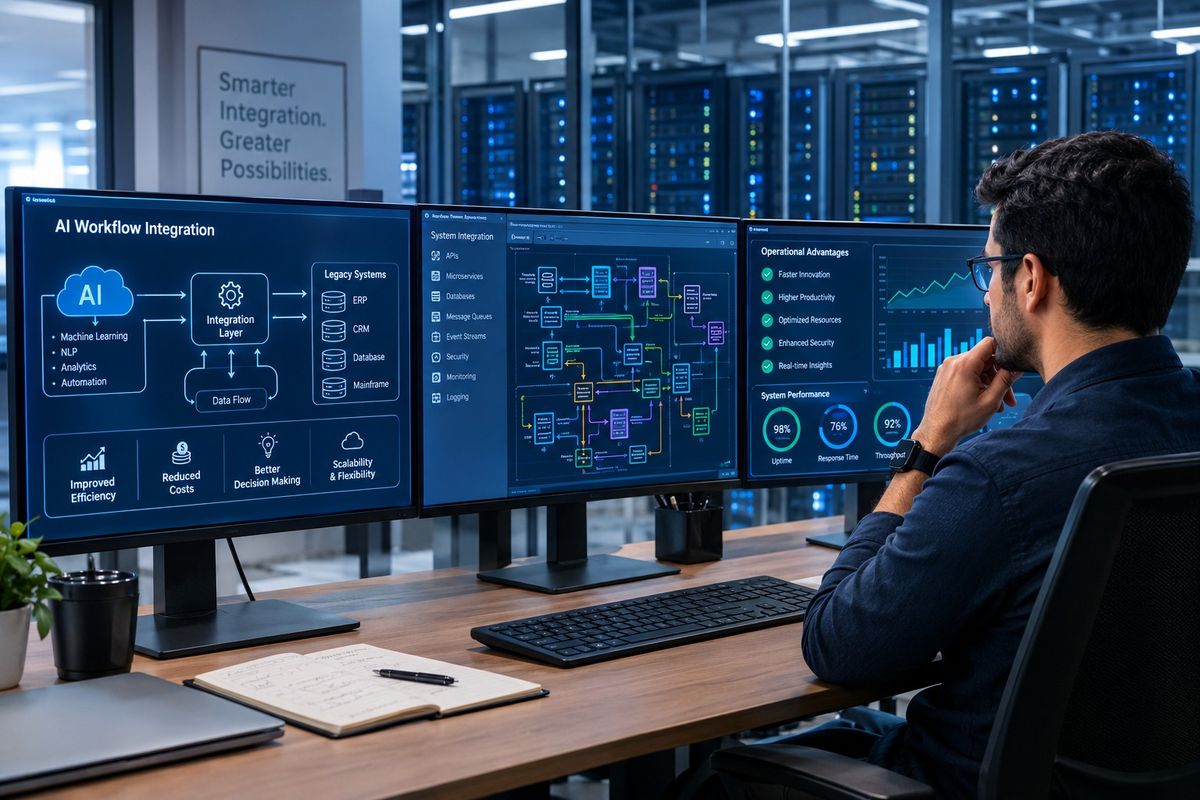
To ensure complete system stability, we build a dedicated middleware environment. This architecture acts as a secure buffer, allowing new AI agents to read and write data to the legacy system via protected RESTful or GraphQL endpoints without causing application slowdowns or crashing core background operations.
4. Custom Model Fine-Tuning & Integration
Next, we deploy specific AI models tailored to solve your unique business bottlenecks. Whether your organization requires advanced natural language processing (NLP) to automate customer support pipelines, or deep neural networks for supply chain forecasting, the models are trained directly on your unique operational workflows.
5. Deployment, Drift Monitoring & Optimization
Once launched, our dev teams monitor system response latency, model prediction accuracy, and pipeline security logs. We continuously tune the models to prevent data drift, ensuring the AI workflows scale smoothly alongside your expanding transactional volume.
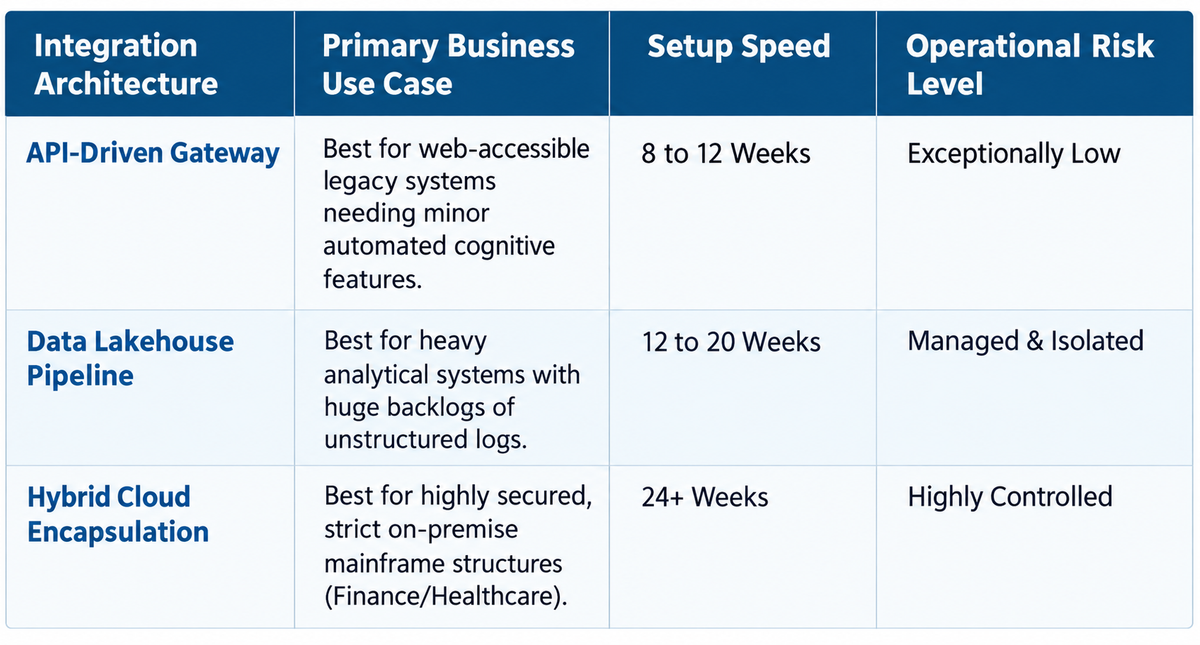
Choosing Your Integration Model
Overcoming Critical Integration Challenges
Challenge 1: The Lack of Native APIs
The Problem: Very old systems (like COBOL or early Java frameworks) do not possess modern web endpoints to talk to cloud AI services.
The Techservint Solution: We build custom data adapter wrappers that securely read system updates directly from the database level, transforming raw files into clean JSON payloads for the AI model.
Challenge 2: System Performance Drag
The Problem: Running heavy machine learning calculations directly inside a legacy server environment can overload the hardware and cause system-wide lag.
The Techservint Solution: We keep the system perfectly optimized by offloading all heavy machine learning computations to isolated, secure cloud environments (like AWS or Azure). The legacy software only handles lightweight text commands.
Challenge 3: Maintaining Data Privacy Regulations
The Problem: Passing sensitive customer information to external public AI engines breaches strict USA data laws like HIPAA or Gramm-Leach-Bliley.
The Techservint Solution: We deploy private, completely open-source models inside your own secure cloud boundaries, ensuring your proprietary operational data never leaves your corporate perimeter.
Why Partner with Techservint for Enterprise Modernization?
Techservint stands out as a premier custom software engineering and digital transformation agency. We specialize in helping modern enterprises maximize the value of their existing software investments by deploying scalable, intelligent automated systems.
We do not believe in applying cheap software patches or pushing clients into unnecessary, high-risk system replacements. Our engineering teams prioritize rock-solid cybersecurity, continuous system uptime, and measurable business ROI. By combining extensive legacy system knowledge with cutting-edge artificial intelligence design, we give your business the ultimate competitive edge.
Frequently Asked Questions (FAQs)
Q: Will this AI integration process cause operational downtime for our users?
No. Because we run all AI workflows through separate, sandboxed middleware layers and secure data pipelines, your primary enterprise application stays fully online and operational throughout the entire integration cycle.
Q: How do you ensure our corporate data remains secure?
We implement elite enterprise security protocols, including AES-256 data encryption at rest and in transit, private virtual networks, and strict role-based access controls (RBAC) to ensure your system meets the highest data protection standards.
Q: How long does it typically take to see measurable ROI from an AI workflow?
Most enterprise clients witness concrete improvements—such as a 40% reduction in manual data processing times or significantly accelerated analytics reporting—within the first 60 to 90 days after going live.
Ready to Unshackle Your Business from Legacy Limitations?
Do not let outdated, rigid IT infrastructures slow down your market expansion. Partner with Techservint to safely harness the power of custom AI agents, machine learning analytics, and predictive workflows directly inside your current software stack.
Our elite team of software development experts is standing by to map out a clear, risk-free technical path aligned with your long-term growth goals.
Schedule Your Free Enterprise Discovery Strategy Session Today