HIPAA Compliant Custom AI Agents for Healthcare Clinics
By Techserv International
The Security Roadmap: Building HIPAA-Compliant Custom AI Agents for Healthcare Clinics
Are your clinic’s administrative workflows slowing down patient care and running up manual overheadFor medical clinical directors, Chief Medical Information Officers (CMIOs), and healthcare IT executives across the USA, integrating artificial intelligence into daily practice settings marks a massive operational upgrade. From automating patient intake screening logs to dynamically transcribing doctor-patient audio notes and updating Electronic Health Records (EHR), intelligent AI agents possess the power to eliminate administrative burnout.
However, the medical field is a highly regulated space where data handling mistakes carry devastating consequences. Unlike traditional web applications, deploying generative workflows inside clinical setups means handling Protected Health Information (PHI). Failing to safeguard these data channels doesn't just mean dealing with system software bugs it triggers severe civil monetary penalties under the Health Insurance Portability and Accountability Act (HIPAA), heavy federal audits, and an irreversible loss of patient trust.
The only acceptable path forward is building HIPAA-compliant custom AI agents for healthcare clinics with privacy-by-design at their core. By engineering isolated data silos, strict identity authentication gates, and auditable logging pipelines directly into your software stack, your clinic can safely leverage the massive benefits of intelligent AI automation while fully protecting patient privacy. Let’s break down the technical roadmap required to deploy update-resilient, compliant AI agents safely within your medical network.
The Compliance Conflict: Consumer AI vs. Healthcare AI
To design an automated, legally compliant medical AI system, engineering teams must move entirely away from standard public cloud models toward zero-trust data setups:
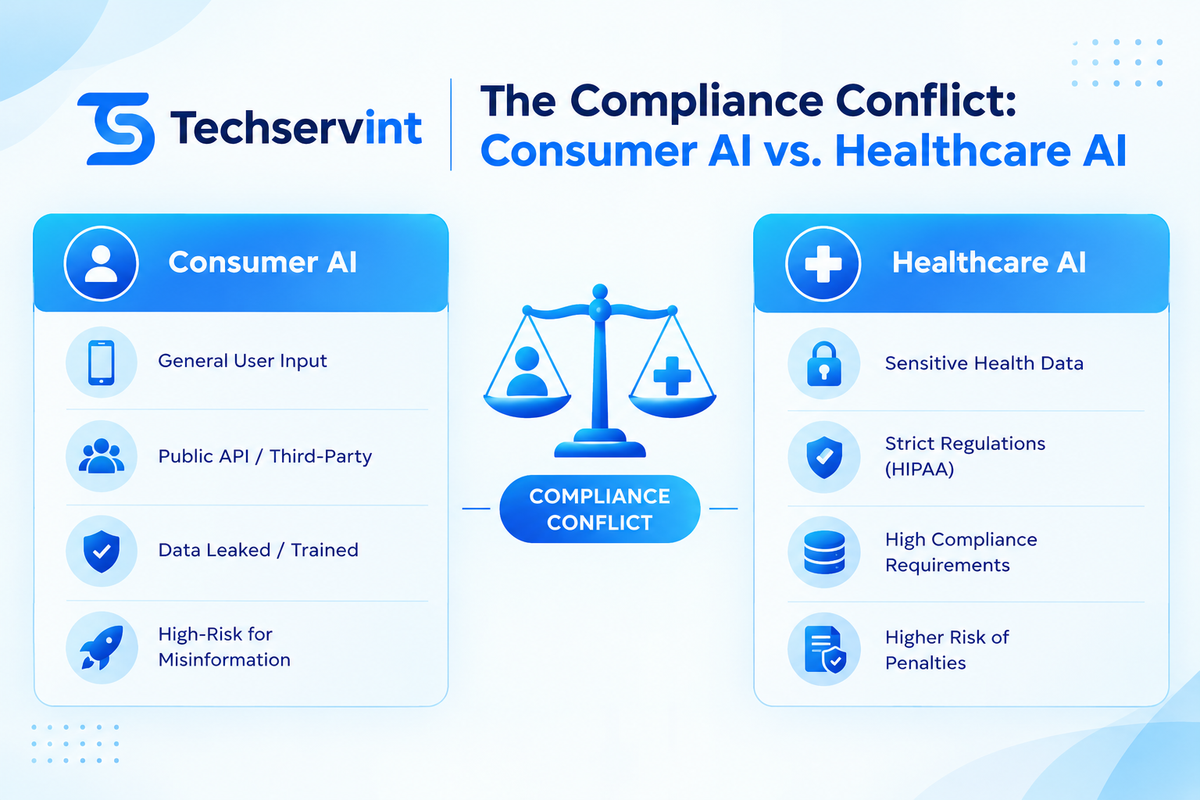
Standard out-of-the-box artificial intelligence services are a disaster for medical data compliance.When a user inputs text into a public language model, that data is routed to external third-party servers where it can be stored, analyzed, and reused to train future public software models. In a medical environment, passing raw patient names, medical histories, or lab charts through these standard channels constitutes a severe, immediate HIPAA violation.
A dedicated healthcare AI agent, conversely, operates under completely different infrastructure principles. Every component of the system from user input forms to backend database directories is built within an isolated, enterprise-grade private cloud boundary. Furthermore, every technology provider involved must sign a legally binding Business Associate Agreement (BAA), ensuring your proprietary patient data remains private and is never stored or used for model training.
Key Operational Benefits of Custom Healthcare AI Agents
Deploying specialized, fully compliant automated agents within a clinical setting unlocks measurable competitive and structural advantages:
- Immediate Administrative Relief: Automate up to 80% of repetitive medical documentation, patient scheduling updates, and insurance validation pipelines.
- Flawless Real-Time EHR Integration: Safely read and update existing electronic health record databases via secure API webhooks without causing sync lags.
- Elimination of Data Spill Vulnerabilities: Built-in data scrubbing tools automatically remove identifiers from system text blocks before passing them to internal processing models.
- Reduced Legal Risk Exposure: Operating on a verified, compliant software architecture protects your medical group from expensive federal compliance investigations.
Technical Framework: The 5-Step Secure Engineering Roadmap
Building an intelligent AI system that satisfies strict federal data regulations requires a disciplined, multi-layered development framework. At Techservint, we secure medical software deployments using this field-tested engineering blueprint:
Step 1: Establishing a Zero-Retention Private Cloud Boundary
We never mix medical operations data with public hosting channels. Our engineers stand up your AI agents inside highly secure, private infrastructure partitions (such as AWS GovCloud or Azure Government) backed by explicit, verified BAAs, ensuring complete data containment.
Step 2: Enforcing End-to-End Cryptographic Encryption (AES-256)
Patient data must remain completely unreadable to unauthorized eyes at every single step of its journey. We implement elite encryption protocols, securing PHI at rest inside database tables using AES-256 encryption, and protecting data in transit across networks using TLS 1.3 encryption tunnels.
Step 3: Integrating De-Identification and Anonymization Filters
To maximize system safety, our custom software architecture strips out sensitive patient identifiers (such as social security numbers, biometric records, and phone numbers) from raw input strings using intelligent processing layers before passing the text to your core analytics models.
Step 4: Structuring Strict Role-Based Access Controls (RBAC)
Not every employee in a clinic requires access to the same medical records. We implement strict, multi-factor authentication (MFA) gates paired with granular role-based permissions, ensuring your custom AI agent only shares sensitive files with verified, authorized medical personnel.
Step 5: Implementing Tamper-Proof Audit Logging Networks
If a regulatory audit occurs, your software must be able to prove exactly how data was handled. We deploy secure, immutable auditing systems that automatically log every single interaction, data view, or modification made by the AI agent into an unalterable tracking registry.
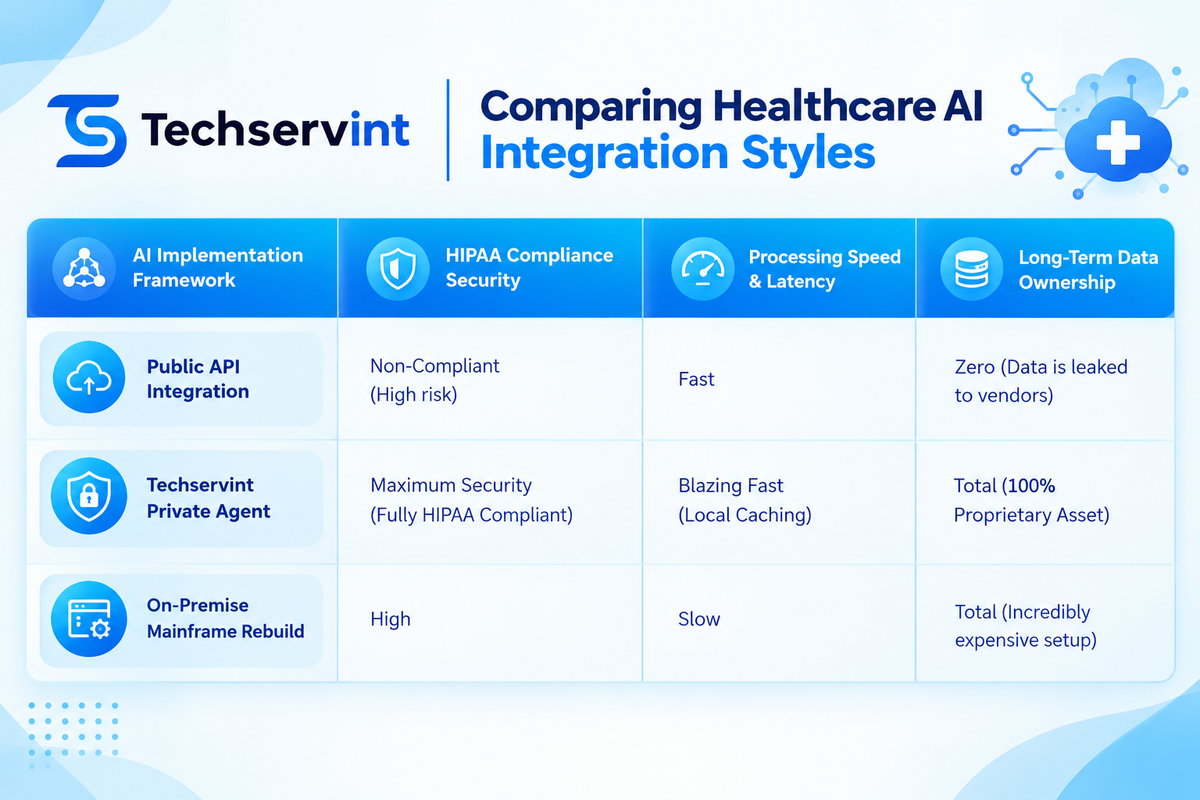
Comparing Healthcare AI Integration Styles
Every healthcare network handles software modernization based on distinct operational budgets, clinical velocities, and security requirements. The matrix below compares the three primary implementation styles:
Overcoming Critical Healthcare Development Challenges
Building artificial intelligence components for strict medical environments introduces unique database hurdles. Here is exactly how our specialized development teams solve them for you:
Challenge 1: Preventing AI Hallucinations in Clinical Decision Notes
- The Problem: Generative software models can occasionally invent incorrect information (hallucinations), which introduces severe clinical risks if included in patient summary sheets.
- The Techservint Solution: We deploy advanced Retrieval-Augmented Generation (RAG) frameworks. This design restricts the AI agent to pulling data exclusively from verified medical databases and specific patient histories, completely blocking it from making unverified assumptions.
Challenge 2: Connecting to Fragmented, Legacy EHR Systems
- The Problem: Many older medical clinics run on rigid, closed EHR platforms that lack modern web endpoints, making it difficult to extract data smoothly.
- The Techservint Solution: We bridge the data gap by engineering custom HL7 and FHIR API connectors, allowing your new AI software to safely read and write updates to older healthcare databases without breaking background code layouts.
Challenge 3: Balancing AI Model Performance with Fast Response Times
- The Problem: Passing user inputs through multiple layers of security, text scrubbers, and encryption protocols can introduce processing lag, frustrating busy doctors.
- The Techservint Solution: We optimize processing latency by utilizing lightweight, heavily tuned local models and deploying smart memory caching layers to deliver safe responses in milliseconds.
Why Choose Techservint as Your Medical Tech Partner?
Techservint is a leading custom software development and digital transformation agency. We specialize in helping modern healthcare organizations, clinical groups, and enterprise firms maximize their computing investments through intelligent business automation components and highly secure, compliant cloud architectures.
We completely reject surface-level patches and unvetted software setups that expose your data to compliance breaches. Our software engineers build rock-solid, scalable database components focused entirely on protecting your data integrity, maintaining continuous system uptime, and driving clear financial ROI. By pairing deep data privacy knowledge with cutting-edge artificial intelligence design, we deliver the definitive technical architecture your clinic needs to lead its market safely.
Frequently Asked Questions (FAQs)
Can we use popular models like ChatGPT or Claude for patient intake if we have a custom wrapper?
Only if you are accessing those models through specific, enterprise-tier API agreements where the vendor explicitly signs a Business Associate Agreement (BAA). Standard public accounts or standard web interfaces violate HIPAA rules instantly.
What happens to patient data logs during an internet or power outage?
Our custom healthcare software builds utilize secure, asynchronous queue architectures. If your local network goes offline, the incoming data files are securely encrypted and cached locally, automatically processing the moment secure cloud connections resume.
How long does it take to build and deploy a compliant AI agent for a clinic?
Depending on how complex your current EHR setup is and how many workflows you want to automate, a fully compliant, tailored healthcare AI agent takes anywhere from 8 to 14 weeks to design, thoroughly test, and safely launch.
Ready to Secure and Automate Your Clinical Workflows?
Stop letting administrative compliance burdens drain your medical staff's valuable time. Partner with Techservint to safely deploy high-performance, fully custom AI applications engineered specifically around your clinic’s day-to-day healthcare mechanics.
Our elite team of enterprise software developers is standing by to structure a low-risk, high-impact digital strategy aligned perfectly with your long-term expansion milestones.