Debugging Unexpected Cloud Compute Cost Spikes Serverless
By Techserv International
FinOps Guide: Debugging and Stopping Unexpected Cloud Cost Spikes in Serverless Apps
Have you ever opened your monthly cloud infrastructure dashboard only to find a shocking, multi-thousand-dollar bill you didn't plan for? For Chief Technology Officers (CTOs), engineering managers, and finance teams across the USA, serverless cloud computing environments (like AWS Lambda, Google Cloud Functions, or Vercel) represent the ultimate operational framework for modern application scaling. The promise is incredibly enticing: zero server management overhead, instant scaling to match incoming user traffic, and a pricing structure where you only pay for the exact millisecond your code runs.
However, the exact same auto-scaling mechanisms that keep your application online during heavy web traffic surges can become a major financial liability overnight. Because serverless environments scale horizontally without built-in restrictions, a minor loop bug, an unoptimized database call, or a distributed denial-of-service (DDoS) attack can trigger millions of unexpected executions in minutes quietly running up catastrophic bills while your internal alerts remain silent.
Regaining absolute financial control over your infrastructure requires an assertive approach to debugging unexpected cloud compute cost spikes serverless apps encounter. By deploying real-time system observability tools, setting rigid execution limits, and implementing proper data query strategies, your engineering team can completely eliminate financial surprises while maintaining peak application speeds. Let's analyze the technical roadmap to finding, debugging, and stopping runaway serverless bills safely.
The Root Causes of Serverless Financial Runaways
To build an update-resilient financial defense perimeter around your codebases, systems architects must understand the common coding errors that trigger sudden bill spikes:
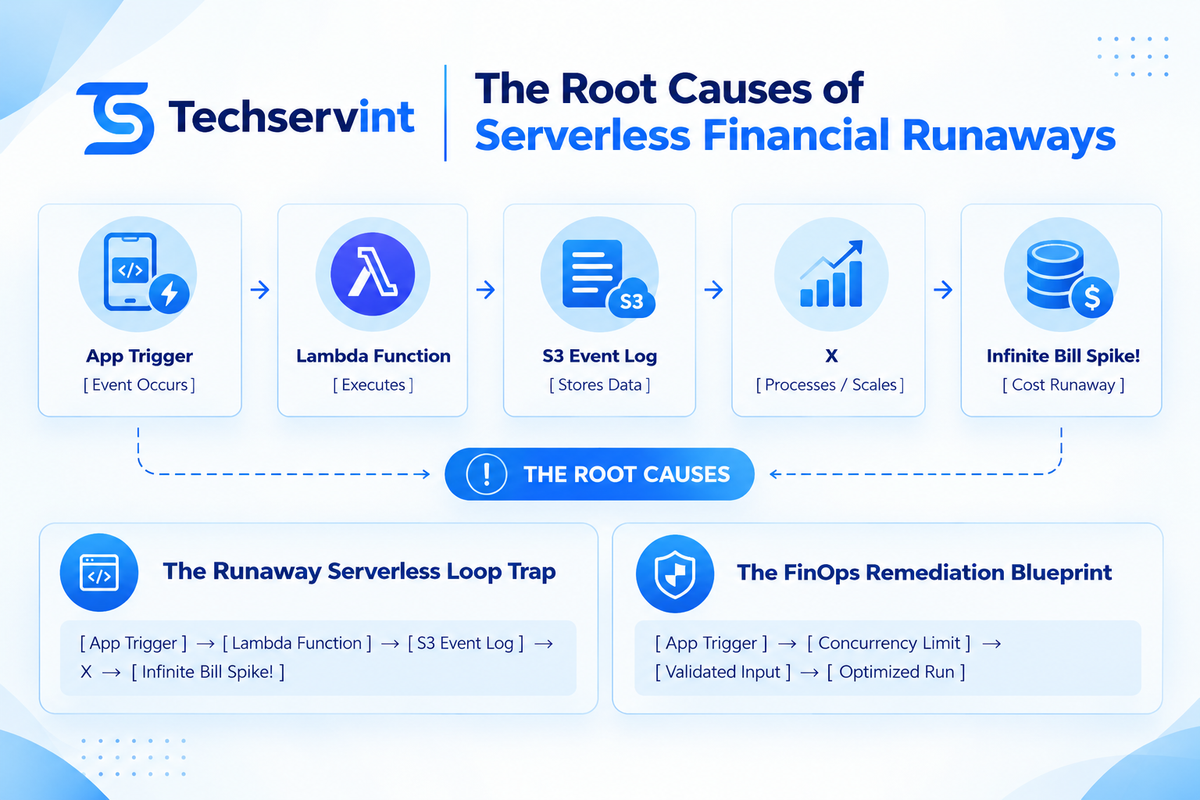
The most common cause of sudden serverless bill inflation is an infinite recursive loop event handler. For example, if a backend function is written to trigger whenever a file is uploaded to a cloud storage bucket (like AWS S3), and that function accidentally writes a modified copy of the file back into the exact same folder directory, it triggers itself again. This creates a continuous, high-speed execution loop that can scale out to thousands of parallel server instances in seconds.
Another massive hidden cost drain is unoptimized database data query mechanics. If a serverless function is configured with a high timeout threshold and spends several seconds waiting around to read unstructured tables from an unindexed database layer, you are billed heavily for completely idle computing time, draining critical startup capital on server waste.
Critical Financial and Engineering Risks of Blind Auto-Scaling
Failing to build strong cost-monitoring workflows directly into your cloud architecture can cause severe business issues:
- Severe Financial Runway Depletion: A single unchecked infinite code loop left running over a weekend can drain a startup's entire seed funding runway.
- Database Connection Overloads: Rapidly auto-scaling backend functions can instantly flood your core databases with thousands of simultaneous queries, causing total platform downtime.
- Susceptibility to Denial-of-Wallet (DoW) Exploits: Malicious bots can flood your public API endpoints with high-volume requests, intentionally inflating your infrastructure bills to force financial distress.
- Loss of Engineering Focus: Forcing development teams to waste weeks manually combing through confusing cloud logs to trace hidden leaks derails core product feature roadmaps.
Technical Framework: 5 Steps to Halting Serverless Billing Leaks
Safeguarding your application's financial efficiency demands a structured, layered FinOps (Cloud Financial Operations) engineering framework. At Techservint, we secure our clients' cloud budgets using this field-tested migration and debugging roadmap:
Step 1: Setting Strict Reserved Concurrency Allocations
We never allow serverless functions to run unthrottled with unlimited scaling pools. Our engineers configure explicit Reserved Concurrency limits across individual functions, establishing a secure performance ceiling that prevents a buggy component from consuming your entire corporate cloud resource quota during a glitch.
Step 2: Implementing Real-Time Asynchronous Timeouts and Limits
Enterprise software components should never be allowed to run indefinitely while waiting on slow data feeds. We configure strict, aggressive execution timeout parameters (e.g., limiting non-analytical tasks to a maximum of 3 to 5 seconds) and implement asynchronous task queues to terminate frozen connections instantly.
Step 3: Deploying Real-Time Anomaly Detection and Billing Alarms
Waiting until the end of the month to review your infrastructure costs is a recipe for financial disaster. We integrate automated anomaly detection tracking directly into cloud management platforms, configuring real-time Slack or SMS alerts that flag unexpected spending spikes within minutes of occurrence.
Step 4: Optimizing Application Code for Cold Start and Memory Efficiency
Serverless billing calculations are based on a combination of execution time and allocated memory size. We profile your backend codebase to strip out heavy, unnecessary code libraries, optimize your database indexing structures, and carefully tune memory settings to ensure functions execute fast with minimal server waste.
Step 5: Constructing Automated Circuit-Breaker Scripts
To protect your business assets against extreme billing crises, we deploy smart infrastructure circuit breakers. If a specific API gateway endpoint experiences an unexpected 500% surge in resource consumption within a 15-minute window, the automated circuit breaker safely takes that isolated route offline, protecting your core budget.
Comparing Modern Cloud Optimization Environments
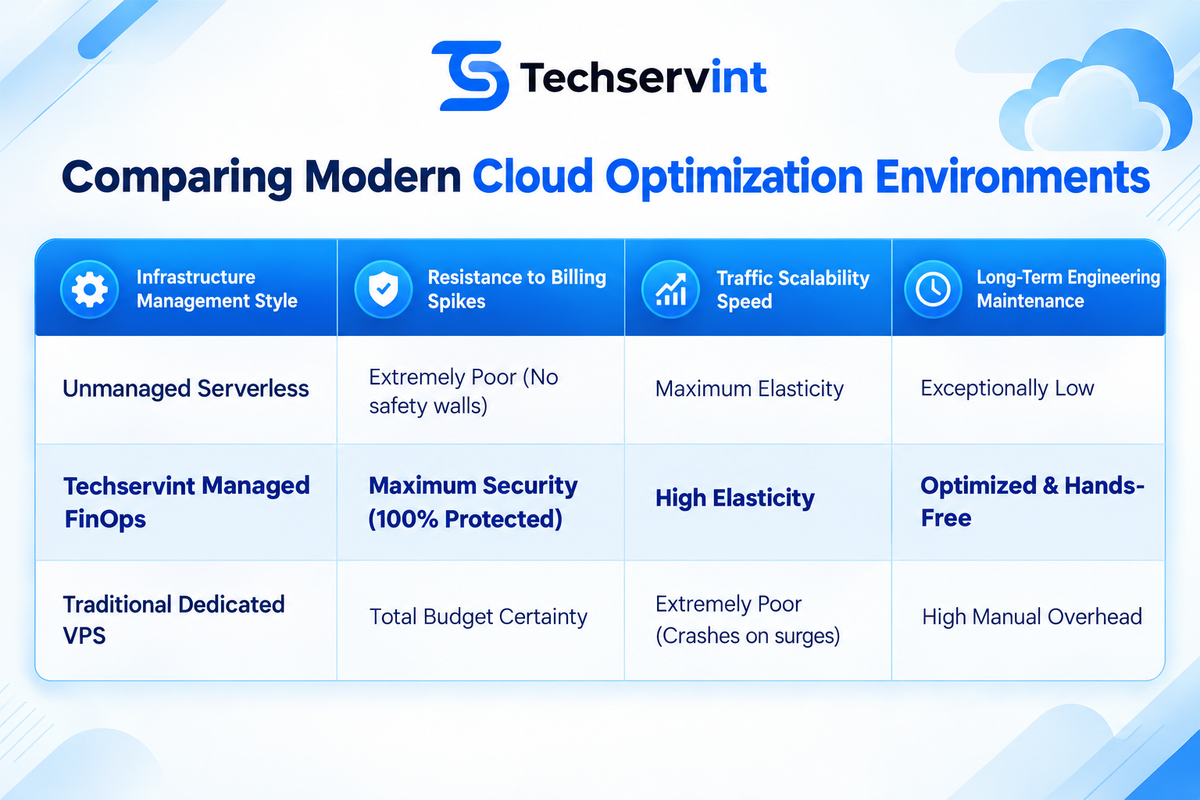
Every scaling digital product handles application deployment models based on distinct traffic patterns, core performance needs, and software customization goals. The comparison matrix below details the three primary scaling styles:
Overcoming Key Challenges in Serverless Financial Auditing
Tracing hidden data movement and computing expenses across distributed cloud environments introduces complex technical hurdles. Here is exactly how our specialized development teams solve them for you:
Challenge 1: Finding the Exact Function Causing the Bill Spike
- The Problem: In a complex microservices architecture running hundreds of separate cloud functions, pinpointing the single line of code triggering the billing spike feels like searching for a needle in a haystack.
- The Techservint Solution: We implement strict, centralized distributed tracing using tools like AWS X-Ray, OpenTelemetry, or Honeycomb, allowing us to trace individual application requests and flag runaway components instantly.
Challenge 2: Separating Real Customer Traffic Surges from Malicious Bot Floods
- The Problem: Setting overly restrictive execution limits can accidentally block real customers from accessing your software during a genuine product launch or viral market push.
- The Techservint Solution: We deploy intelligent web application firewalls (WAFs) and rate-limiting middleware (like Cloudflare Advanced Rate Limiting) at the edge network layer to block malicious bot queries while keeping routes wide open for genuine consumers.
Challenge 3: Balancing Cost Tuning with System Performance
- The Problem: Lowering a function's memory configuration to save money can backfire, causing the application code to run significantly slower and ultimately costing more due to longer execution times.
- The Techservint Solution: We use automated performance profiling tools to test your functions across various configurations, finding the perfect sweet spot where memory allocations and processing speeds combine for the lowest possible cost per execution.
Why Partner with Techservint for Your Cloud Optimization Needs?
Techservint is a leading custom software engineering and enterprise digital transformation agency. We specialize in helping modern organizations maximize their computing assets through intelligent business automation components and highly secure, optimized cloud system design patterns.
We do not believe in superficial fixes or forcing clients into rigid server structures that limit business agility. Our software engineers build rock-solid, scalable database systems focused entirely on protecting your data integrity, maintaining continuous system uptime, and driving clear financial ROI. By matching deep cloud architecture knowledge with cutting-edge FinOps data analytics, we deliver the definitive technical framework your business needs to lead its market safely.
Frequently Asked Questions (FAQs)
Can a DDoS attack directly cause a massive serverless cloud compute cost spike?
Yes. Because default serverless functions auto-scale automatically to process incoming traffic, a malicious denial-of-service attack targeting your public web addresses will trigger thousands of simultaneous functions, resulting in a massive bill spike unless you have a secure firewall filter in place.
Is it possible to set an absolute hard spending limit that turns off cloud services when reached?
While cloud vendors allow you to configure granular monitoring alerts and tracking budgets, they do not provide a simple button to completely turn off accounts instantly, as doing so could cause catastrophic data corruption. Instead, you must deploy custom circuit-breaker automation scripts to safely isolate runaway systems.
How often should our engineering team run FinOps code optimization reviews?
We highly recommend embedding automated code profiling scripts directly into your CI/CD deployment pipelines to review system performance on every code change, combined with comprehensive manual infrastructure spending audits at least once every quarter.
Ready to Secure Your Cloud Infrastructure Budget?
Stop letting unpredictable serverless scaling risks threaten your company's financial runway. Partner with Techservint to securely deploy advanced FinOps observability tools and robust system guardrails designed to completely eliminate unexpected cloud compute costs.
Our elite team of enterprise software developers is standing by to structure a low-risk, high-impact digital strategy aligned perfectly with your long-term expansion milestones.