Building PCI-DSS Compliant Payment Orchestration Platforms
By Techserv International
The FinTech Blueprint: Building PCI-DSS Compliant Payment Orchestration Platforms
Are you losing revenue every month due to false declines and outages on a payment gateway? CTOs, Product Leaders working within FinTech and high volume E-commerce companies throughout the USA suffer greatly from using a single payment processor. If the main payment gateway suffers an API outage or falsely flags valid international payments as fraud, this will cause your checkout to stop resulting in cart abandonment.
Large scale businesses are now looking to reduce single points of failure by putting in place a payment orchestration layer that allows transactions to be routed to multiple payment service providers (PSP's), Acquirers and Fraud Prevention platforms. This however creates massive risk as credit card data needs to be passed to multiple different locations.
The best solution is to build payment orchestration platforms that are PCI DSS compliant that utilize secure isolation. Using intelligent routing, network tokenization and secure isolation of cardholder data, the engineering team can ensure the highest approval rates whilst protecting the core business from any major compliance issues. Below is a breakdown of the technical requirements to build a secure payment orchestration platform.
The FinTech Shift: Single Gateway vs. Payment Orchestration
To build a resilient financial transaction layer, systems architects must transition away from hardcoding individual payment APIs directly into their user-facing applications:
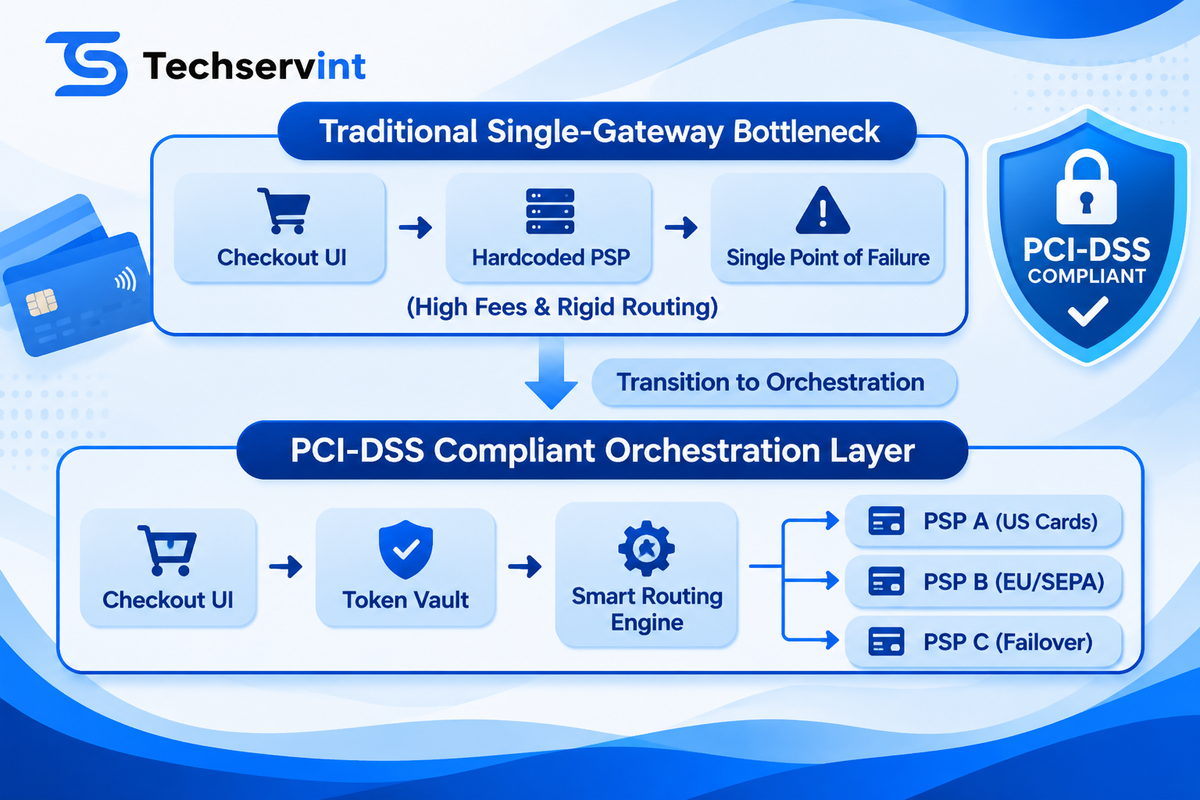
Traditionally, your checkout will communicate directly with your chosen payment processor (Stripe/Adyen etc.) If you want to add a secondary fallback option, or wish to support local payment options when expanding internationally, your developers will need to rewrite large chunks of your checkout, deal with different webhook structures, and also have different ledgers.
A Payment Orchestrator can be used as an intelligent layer between your checkout application and payment providers. It takes one standardized API call from your front end, replaces your sensitive PANs with security tokens, and applies intelligent rules to help decide which payment provider to send your transaction through. These rules can include which country the card BIN is from, what currency it is and whether your gateway is up. This means you are sending your transaction through the payment provider most likely to approve it, at the cheapest cost.
Key Strategic Advantages of Payment Orchestration
By building a bespoke payment routing solution you will have immediate competitive and commercial benefits, including:
- Higher Transaction Approval Rates: Increased transaction approval rates by automatically re-submitting failed payments to an alternative back-up acquiring partner in just a few milliseconds.
- Drastic Reduction in Processing Fees: Reduced processing costs by routing domestic debit cards to low cost local networks, and complex international credit cards to specialist global payment acquirers.
- Minimized PCI-DSS Audit Scope: Reduced PCI-DSS compliance scope by keeping cardholder data contained to your compliant payment vault. This means that your core application servers are not included in PCI compliance.
- Rapid Global Market Expansion: Quickly enter new markets by easily adding new regional payment methods, digital wallets and BNPL partners through our one API. You do not need to modify your core checkout.
Technical Framework: 5 Steps to Architecting Compliant Payment Systems
To deliver a secure platform for processing payments, we follow a strict approach to developing our financial routing engine to ensure it meets all requirements set by the Payment Card Industry Data Security Standard (PCI-DSS v4.0). At Techservint we build scalable FinTech platforms through following this best practice approach:
Step 1: Cardholder Data Environment (CDE)
We will never expose credit card numbers or CVVs to your application server or database. Instead our engineers will create a highly segmented Zero Trust environment (known as a Cardholder Data Environment - CDE), which will house your payment processing. This will be deployed onto an isolated cloud such as AWS/Azure and will have strict rules around firewall access.
Step 2: Network Tokenization & Vault
To remove the need to bring your core business logic into scope, we will create a tokenization vault within the CDE. When a customer submits payment details within the hosted iFrame, the payment details are encrypted using AES-256 standards to produce a safe token. This token will then be stored and processed within your application.
Step 3: Smart Dynamic Routing Engine
Once we have secured the environment, we will develop our routing engine using a high throughput backend language such as Go or Rust. The rules will be dynamic and can be adjusted based on payment amount, issuing country, currency conversion and live gateway status.
Step 4: Idempotent APIs & Cascading Retry
During payment processing a timeout can occur causing double charging of payments. To avoid this we enforce all our API endpoints to have strict Idempotency Keys. This ensures that any payment requests will only be processed once. If there is a soft decline or timeout from a downstream gateway, the orchestrator will automatically trigger a cascading retry.
Step 5: Automated Reconciliation & Audit Logging
Processing payouts across 5 different payment gateways can become very complex. We will develop automated webhook listeners and reconciliation engines. This will allow us to normalize data received from all your connected PSPs into one financial dashboard with audit logs which will be tamper proof for your annual PCI-DSS assessment.
Comparing Payment Infrastructure Deployment Models
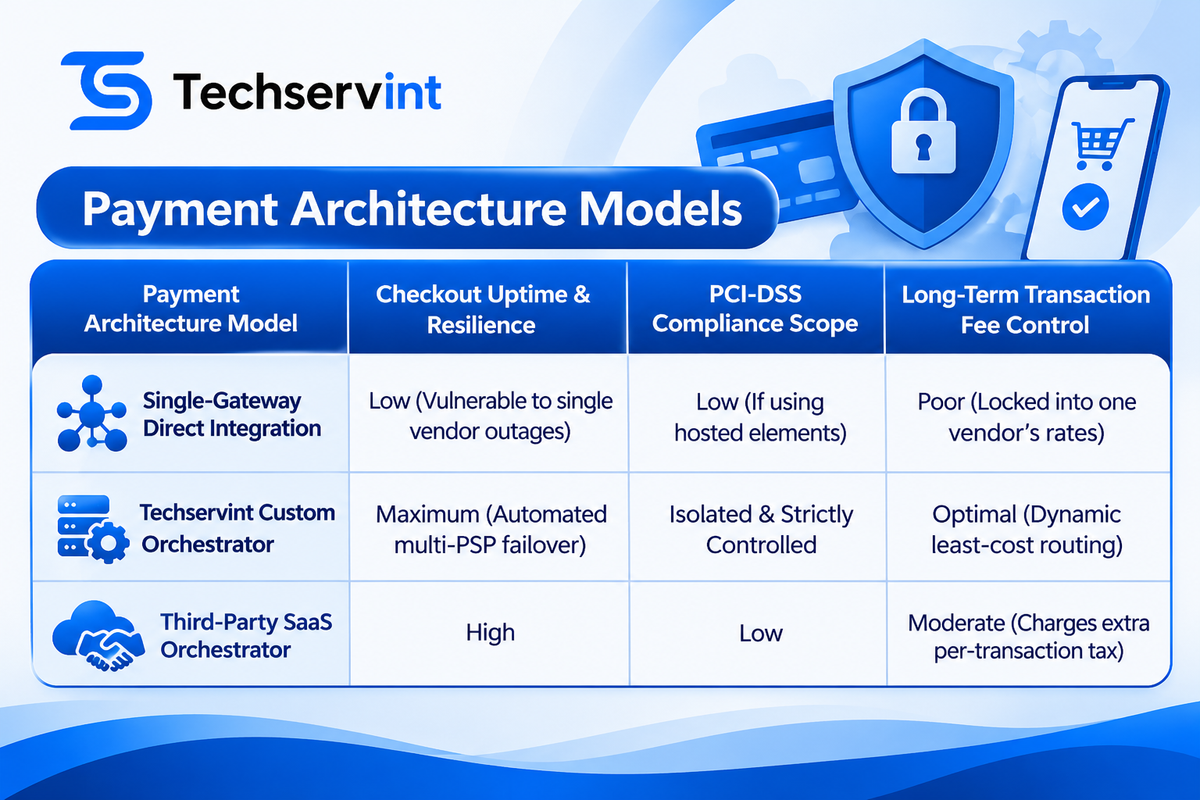
All scaling enterprises will have some form of financial infrastructure in place to manage transaction volume, engineering resource and compliance costs. This matrix compares the 3 major payment infrastructures:
Overcoming Key Technical Challenges in FinTech Engineering
Creating a high availability finance routing solution can create challenges when trying to maintain data integrity and security. Below are the solutions our expert engineers will provide:
Challenge 1: Preventing being locked into a payment gateway
- The Problem: Many payment gateways offer tokenization services. If you choose to change payment gateways you risk being stuck within their payment gateway with your recurring subscription payments.
- The Techservint Solution: We configure a payment agnostic tokenization solution to occur on your own CDE vault. This means that you have control of your encryption keys and can send your customers recurring payment tokens to any payment processor globally without asking them to re-enter their card details.
Challenge 2: Sub-Second Latency Across Multiple Fraud Checks
- The Problem: Putting transactions through your own router, token vault, 3D secure and fraud scoring can impact the speed of your checkout and cause cart abandonment.
- The Techservint Solution: By using asynchronous API calls with high speed cache (Redis) and compiled go microservices we’re able to make fast fraud scoring and BIN lookups under 50ms.
Challenge 3: PCI-DSS v4.0 client side scripting
- The Problem: Modern PCI-DSS v4.0 regulations enforce strict controls over JavaScript running on checkout pages to prevent e-skimming and Magecart browser attacks.
- The Techservint Solution: We ensure that all of your checkout fields have Content Security Policies (CSP), Sub-resource Integrity (SRI) and script monitoring headers in place to fully protect against unwanted changes to browser scripts.
Why Partner with Techservint for FinTech Infrastructure?
We are premier bespoke software engineers and enterprise digital transformation specialists who help modern FinTech start-ups, SaaS and high-volume retail companies create robust high throughput financial infrastructure.
Our engineers do not create patchy software solutions. Instead, we design robust, modular payment solutions which are focused on maximizing approvals. Our engineers also ensure that there is continuous uptime and that customer data remains secure. We have deep PCI-DSS compliant infrastructure with cutting edge cloud infrastructure to create the ultimate financial infrastructure solution for your business.
Frequently Asked Questions (FAQs)
When does it become cost-effective to build a bespoke payment orchestrator?
Generally speaking, when your business is processing over $1-2million of payments per month (or multiple international currencies), the time it takes for your lowest cost routing and recovered false declines to outweigh the development costs will be reached pretty quickly.
Can we integrate with our existing ERP / Accounting solutions?
Yes! We design our orchestrators with an API-first approach so we can easily set up webhooks to send standardized settlement information, refunds and fees into your Odoo / NetSuite / bespoke finance systems.
How long does it take to develop a PCI compliant orchestration platform?
Around 10-16 weeks. How many payment gateways and local payment methods you need to support will depend on how many you need to have available straight away.
Want to Take Control of Your Global Payment Infrastructure?
Don’t let single gateway failures, inflexible pricing and inaccurate payment rejections hold you back. Work with us to design a secure high performance PCI-DSS compliant payment orchestration solution that works for your business.
Our elite team of financial software developers are here to help create a technically sound strategy that will help grow your business with minimal risk.