Automated GDPR CCPA Data Compliance Software Architecture
By Techserv International
Designing Automated GDPR and CCPA Data Compliance Directly into Your Software Architecture
Are your development teams spending hundreds of manual hours scrambling to locate and wipe consumer data files every time a privacy request comes in? For Chief Technology Owners (CTOs), enterprise architects, and engineering managers across the USA, data privacy is no longer just a legal checkbox. With the continuous expansion of strict regulatory laws such as the European Union’s General Data Protection Regulation (GDPR) and the California Consumer Privacy Act (CCPA) improper data handling introduces catastrophic financial risks, massive regulatory fines, and permanent brand erosion.
The traditional approach to data privacy is fundamentally broken. Most legacy platforms treat privacy as an afterthought, relying on manual database scripts and chaotic spreadsheets to handle complex compliance requests like the "Right to be Forgotten" (Data Erasure). When a system scales to manage millions of active user entries spread across disconnected microservices, cloud storage buckets, and third-party APIs, this manual patching process fails leading to severe compliance leaks.
The definitive path to risk mitigation is engineering a system focused on automated gdpr ccpa data compliance software engineering architecture. By designing automated data mapping pipelines, cryptographic encryption wrappers, and localized storage isolation zones directly into your software blueprint, your organization can completely automate compliance workflows, protect consumer data integrity, and ensure smooth operational scaling. Let's analyze the technical roadmap to building an update-resilient, privacy-by-design framework for your enterprise systems.
The Privacy Shift: Monolithic Sprawl vs. Privacy-by-Design
To build an automated compliance environment, systems architects must move away from unstructured data pooling toward a highly isolated data processing architecture:
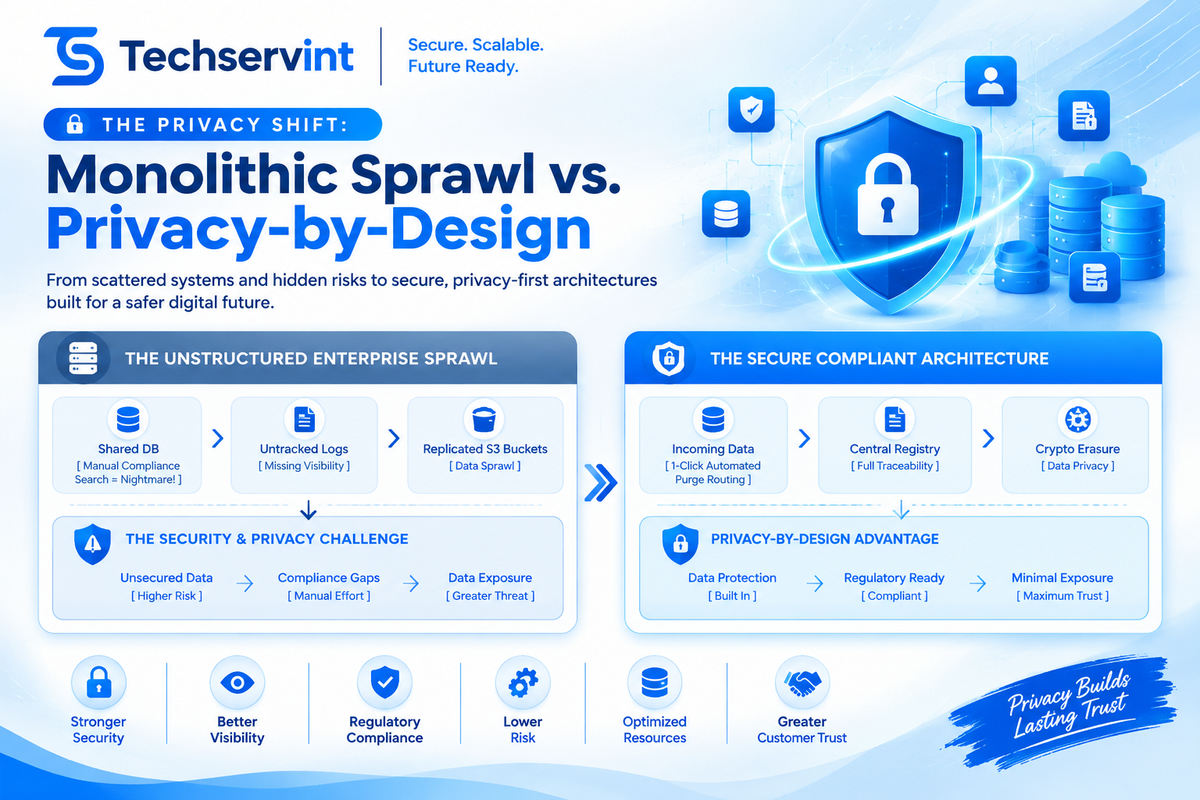
Traditional software application development models treat databases as a singular massive bucket. User records, system log metrics, transactional histories, and personally identifiable information (PII) are mixed together, shared across memory states, and copied into unstructured cloud storage pipelines. When a consumer exercises their legal right to access or delete their personal data, finding every instance of that individual's data becomes a massive technical bottleneck.
Conversely, an automated compliance architecture implements strict "Privacy-by-Design" principles at the foundational database layer. The moment an external data payload enters your application programming interfaces (APIs), the system categorizes, tags, and isolates sensitive records into protected database containers. Rather than running slow database searches across your entire network, your software reads specialized telemetry maps to identify and wipe relevant records instantly.
Key Strategic Benefits of Automated Architecture Compliance
Building automated compliance controls directly into your application structures provides immediate, measurable business advantages:
- Instant Automation of Privacy Requests: Fulfill complex Data Subject Access Requests (DSARs) and data deletion queries in seconds instead of weeks.
- Elimination of Human Error Risks: Remove manual data purging routines, ensuring your systems clean out records accurately without accidentally deleting core application data.
- Elite Protection Against Data Breaches: Implementing isolated token spaces ensures that even if a system server is compromised, your core consumer data remains fully encrypted.
- A Massive Competitive Advantage in the B2B Market: USA enterprise clients prefer to partner with engineering firms that possess verified, built-in structural data compliance protocols.
Technical Framework: 5 Practical Steps to Compliance Automation
Architecting an enterprise platform to manage international data rules safely requires a highly disciplined, risk-mitigated technical roadmap. At Techservint, we secure your technical assets using this proven five-step engineering roadmap:
Step 1: Real-Time Data Classification and Automated Tagging
We never allow unstructured PII to sit untracked in your databases. We implement automated metadata tagging layers directly inside your application ingestion scripts, automatically labeling incoming variables (such as email addresses, location coordinates, or payment histories) with explicit compliance tags.
Step 2: Deploying the Crypto-Erasure Design Pattern
Wiping hard records across distributed backup systems is incredibly complex. Instead, we implement the advanced Crypto-Erasure design pattern, encrypting an individual's PII with a unique, dedicated cryptographic key. When that user submits a deletion request, the system simply deletes that specific encryption key, instantly turning all replicated data blocks into useless text across all backup directories.
Step 3: Setting Up a Central Data Mapping Registry
To ensure complete system visibility, we engineer a centralized, dynamic data registry. This system hooks into all internal microservices and external third-party software integrations, tracking exactly where user data moves across your technology infrastructure in real time.
Step 4: Automating Retention Lifecycles and Data Pruning
Holding onto old consumer data indefinitely is a major regulatory liability. We code automated data pruning engines that continuously track the age of your database entries, automatically archiving or destroying old records the moment they cross your pre-configured corporate retention limits.
Step 5: Constructing Continuous Compliance Audit Trails
To easily pass strict regulatory inspections, your application architecture must generate clear proof of compliance. We deploy secure, tamper-proof audit log networks (using immutable ledger architectures) that automatically record every data access, modification, or erasure action for your compliance teams.
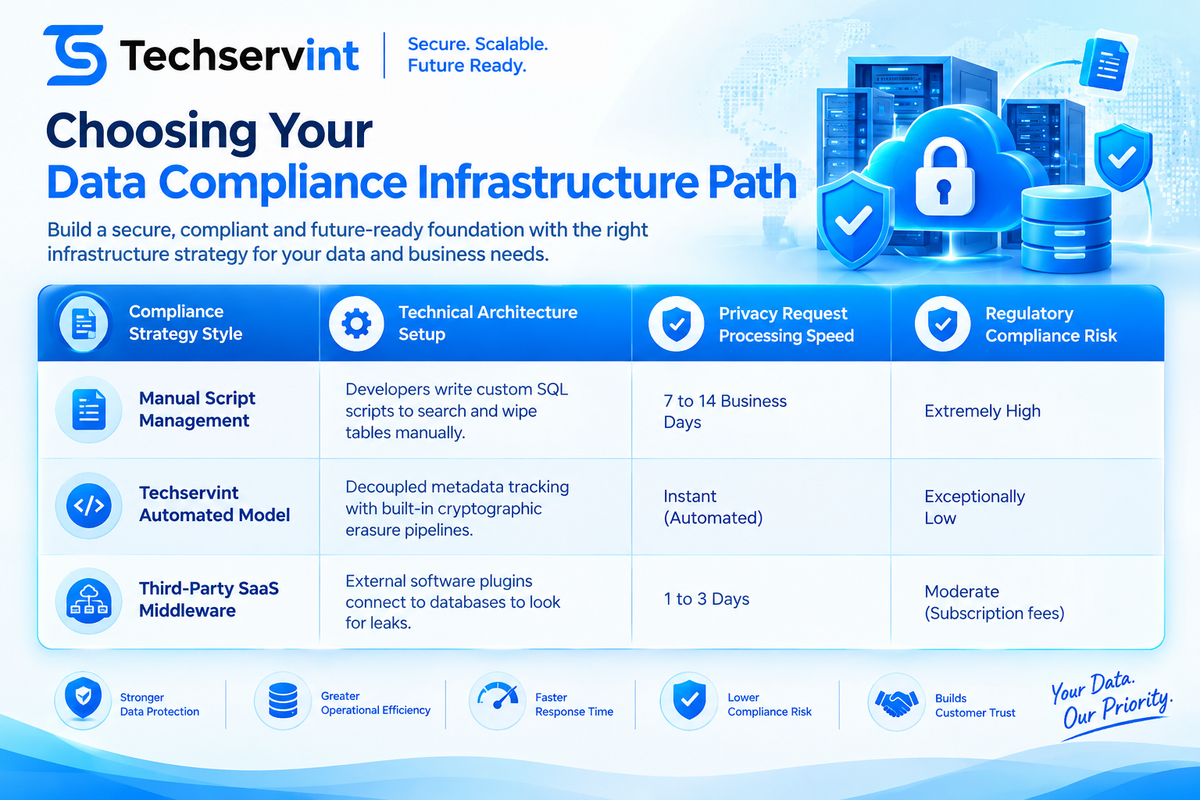
Choosing Your Data Compliance Infrastructure Path
Different business architectures handle compliance automation based on distinct transactional volumes, development budgets, and infrastructure configurations. The comparative matrix below details the three primary engineering methods:
Overcoming Key Technical Challenges in Compliance Engineering
Building resilient compliance walls inside complex enterprise platforms introduces unique database and system challenges. Here is exactly how our specialized development teams solve them for your business:
Challenge 1: Wiping Data from Immutable System Backups
- The Problem: GDPR and CCPA rules demand total data deletion upon user request, but altering or removing single lines of code inside compressed, immutable cold backups is structurally impossible.
- The Techservint Solution: We deploy the Crypto-Erasure pattern at the base data ingestion layer. By completely destroying the specific user decryption key rather than attempting to modify the backup file, the historical data blocks instantly become fully compliant and scrambled.
Challenge 2: Maintaining System Speeds with Multi-Layer Security
- The Problem: Encrypting every single user data field and running continuous classification checks can slow down database queries, causing application lag.
- The Techservint Solution: We keep your platform fast by using high-speed column-level database encryption, caching frequently used non-PII metrics in fast Redis networks, and running heavy data compliance workflows in isolated background processes.
Challenge 3: Tracking Data Flow Across Third-Party Software
- The Problem: Once your application passes user information to external marketing tools or payment processors via APIs, ensuring those systems delete the records when requested is highly difficult.
- The Techservint Solution: We engineer automated compliance webhooks directly into your API pipelines. The moment a user submits a deletion query on your site, our system automatically triggers matching data removal requests to all connected third-party tools simultaneously.
Why Partner with Techservint for Your Enterprise Engineering?
Techservint is a leading custom software development and enterprise digital transformation agency. We specialize in helping modern organizations maximize their computing assets through intelligent business automation components and highly secure, compliant system design patterns.
We do not believe in superficial fixes or unvetted software templates that break during version updates. Our software engineers build rock-solid, scalable database components focused entirely on protecting your data integrity, maintaining continuous system uptime, and driving clear financial ROI. By pairing deep data privacy engineering with cutting-edge microservices architecture, we deliver the definitive technical framework your business needs to lead its market safely.
Frequently Asked Questions (FAQs)
Does hosting our enterprise database in the USA exempt us from GDPR rules?
No. GDPR regulations are based on the citizenship of the consumer, not the location of the server. If your USA-based tech company processes the personal information of a single user located within the European Union, your business must fully comply with GDPR rules.
Can automated compliance architectures handle multiple conflicting state laws?
Yes. We engineer flexible, rule-based data mapping layers into your software architecture, allowing the application to adjust its privacy rules dynamically based on the user's location, seamlessly satisfying CCPA, GDPR, and other emerging state regulations.
How long does it take to integrate an automated compliance setup into an existing application?
Depending on the size and complexity of your legacy codebase, building an automated compliance tracking registry and data mapping layer typically takes anywhere from 6 to 12 weeks to complete safely.
Ready to Secure Your Enterprise Data Architecture?
Stop risking massive regulatory fines and manual data processing bottlenecks. Partner with Techservint to securely deploy advanced compliance automation tools and robust system guardrails designed to keep your business fully aligned with modern data privacy laws.
Our elite team of enterprise software developers is standing by to structure a low-risk, high-impact digital strategy aligned perfectly with your long-term expansion milestones.