How AI Is Changing Enterprise Operations
By Techserv International
How AI Is Changing Enterprise Operations
AI has entered the enterprise fray, and the debate about it has shifted from whether companies should invest in the technology to how soon they can do so without harming vital operations that make them money. From streams as diverse as logistics, sales, finance, and personnel, AI is set to change everything.
For companies that find themselves in the position of having to choose between being stuck with legacy systems and adopting cloud-based or automated solutions, the former has far fewer advantages over the latter. In this article, we will discuss the benefits of implementing AI at your enterprise, the benefits of working with a trusted partner, and how you can benefit from delegating some of these operations to third-party companies.
What Does AI in Enterprise Operations Actually Mean?
When people start talking about artificial intelligence in enterprise operations, they usually refer to the collective use of machine learning, natural language processing, predictive analytics, and intelligent automation in performing essential core functions, not as stand-alone processes but rather as part of a comprehensive enterprise management system.
This includes:
- Enterprise AI solutions embedded into ERP and CRM systems
- AI automation for business for the automation of processes such as invoicing, procurement, and reporting
- Machine learning in enterprise forecasting and risk management
- Intelligent chatbots and virtual assistants that perform internal and customer support tasks
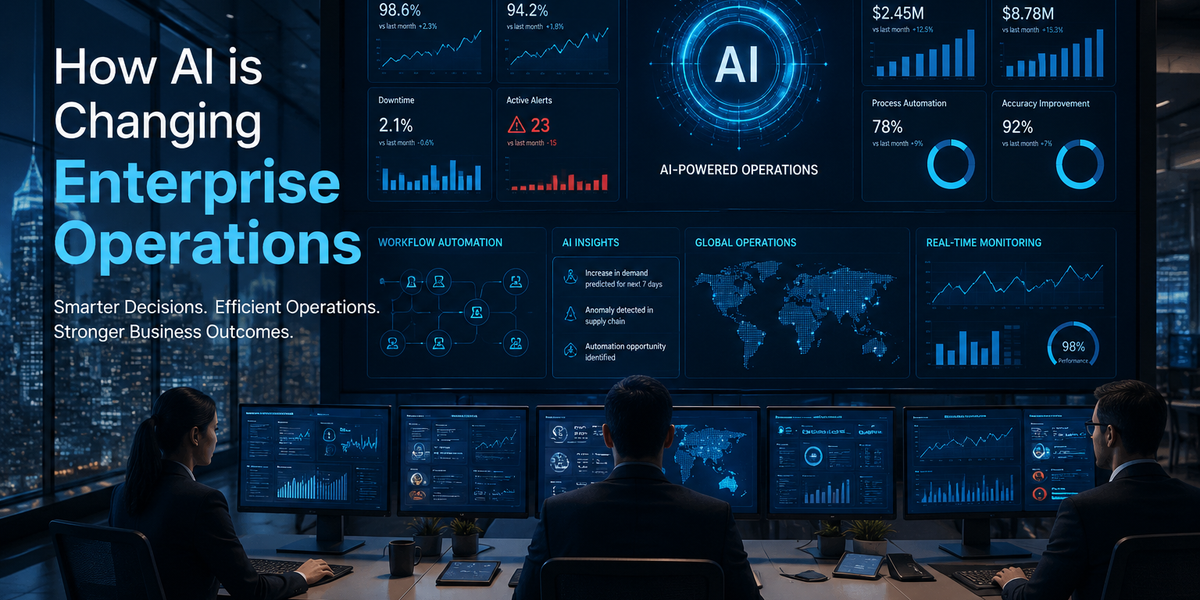
Unlike generic software, which is designed to carry out its functions in a particular way, AI can be taught to be more effective, more efficient, and therefore more valuable with time and use. [Image: A modern enterprise operations control room with dashboards displaying AI analytics – Alt text: AI in enterprise operations dashboard]
Why This Shift Is Happening Now
Three separate trends are coming together to make business process automation more appealing than ever before: advances in cloud infrastructure, the explosion of data, and a growing abundance of readily available generative artificial intelligence (AI). These three trends together open the doors to companies that previously could not afford to automate their business processes. They will profit from investing in artificial intelligence
Key Benefits of AI-Driven Enterprise Operations
Businesses are embracing AI to drive improvements throughout their operations.
1. Faster, Data-Driven Decision Making
With AI, you can quickly analyze vast amounts of data, resulting in faster and more informed decision-making for leaders.
2. Reduced Operational Costs
In addition, enterprises are capitalizing on automation to perform various tasks such as data entry, scheduling, and quality control, thereby reducing expenses related to staff and errors associated with manual work.
3. Improved Customer Experience
AI-driven chatbots, personalization engines, and similar applications allow enterprises to meet the rising expectations of customers while at the same time being more efficient.
4. Stronger Risk Management
Finally, many companies are using AI for machine learning applications for fraud detection, regulatory compliance, and other crucial functions.
5. Scalability Without Proportional Headcount Growth
Companies are also leveraging AI to enable their business processes to handle more data without requiring proportionate increases in staff.
How AI Implementation Works: Our Process
Unlike the generic "Plug and Play" approach, integrating AI technologies into the enterprise environment is a well-defined process. Here is a step-by-step breakdown of our comprehensive digital transformation strategy:
Step 1: Operational Assessment
We begin our cooperation by analyzing your business processes to identify the most suitable candidates for automation.
Step 2: Strategy & Roadmap Development
Secondly, we step back and rather than give you all possible solutions present you with a strategy and roadmap for realising value both short and long term.
Step 3: Integration & Deployment
Thirdly, we start with the implementation of your AI/ML roadmap by embedding agents in your IT-landscape (ERP, CRM, etc.) making sure that people are on board with the changes.
Step 4: Training & Change Management
Without proper change management, even the best technology will collect digital dust. This is why we focus on empowering your teams to unlock the maximum possible efficiency gains and minimize any disruptions.
Step 5: Monitoring & Optimization
We monitor the performance of AI models to ensure they deliver the promised benefits. After all, software systems require tuning to achieve the best results.
To see how this fits into a broader technology strategy, visit our [https://techservint.com/services].
Why Choose Techservint for Enterprise AI Transformation
Not all technology partners understand the nuances of large-scale operations. Techservint has the technical expertise and enterprise knowledge to support your complex technology initiatives across the US market.
- Proven enterprise experience across finance, logistics, healthcare, and manufacturing sectors
- Custom-built AI solutions, not a one-size-fits-all approaches
- End-to-end support, from strategy design through continuous improvement initiatives
- Transparent reporting so business insights that drive executive decision-making and ROI realization.
Learn more about our team and approach on our [https://techservint.com/about], or explore related capabilities on our [Business Automation Services page — Internal Link].
Frequently Asked Questions
1. What is the difference between AI and traditional automation in enterprise operations? Traditional automation is limited by it’s programmed set of rules, while AI can learn and adapt to become more efficient and effective over time.
2. Is implementation of AI only available for bigger companies that can afford to pay for expensive technologies? No, many enterprise class products are modular and designed in a way that allows companies to invest in AI development in an affordable and scalable manner. Therefore, even medium-sized businesses may consider adopting AI.
3. What department yields the highest benefit from being automated by means of AI? Financial, customer service, supply chain, and human resource departments are traditionally the most attractive candidates for automation because they yield the highest benefits.
4. How long does AI take to implement in enterprise operations? It depends on the company and solution, but most often these projects take between 3-6 months to yield results, with 12-18 months for a major transformation initiative.
5. Does AI implementation eliminate employees from enterprise operations? AI replaces mundane repetitive tasks with less error prone and more efficient digital processes, while letting humans focus on higher value work, not necessarily eliminating jobs.
Ready to Future-Proof Your Enterprise Operations?
AI is quickly becoming a necessity for any USA Based company that wants to remain competitive in the national market place. The companies that embrace AI now will be the ones that have an advantage over their peers in the years to come.
Talk to Techservint today and book a free consultation to see exactly how AI can transform your operations. https://techservint.com/contact